Friday, July 21, 2017

Sabbatical Day 6, Part 1 - Morning at the Louvre

Saturday, 10 June 2017

Treasure Hunt
We returned to the Louvre, this morning, and I got to make my "Everybody spells it wrong, the first time" joke about the Denon Pavilion with some new people. Coco and Gwen seemed to be taking deep breaths as the guide for our museum treasure hunt chuckled politely.


We were one of two families participating. The other, also from America, included a dad and very competitive mom, a boy about 8 and another about 14, the latter son seeming distinctly disinterested in this project.

The object of the hunt was to locate and photograph (with one of your group in the photo) artworks described in a pictorial guide. The group was required to stay together; if your opponent group should see anyone in your group more than ten feet from the rest, they could take a photo of the gap in order to dock you 10 points per foot apart! No running, no internet, no GPS, no asking Louvre employees for directions. We agreed to a 90-minute hunt; overtime would cost 2 points per minute.

Maps were essential for locating the works. Gwen thought that a selfie stick (sold for €1 from vendors ALL OVER the grounds) would be another essential. But, no, we couldn't stop to purchase one on our way in. We had "skip the line" tickets and were descending the Pyramid into the museum before anything could even be argued about it.

The matter of a selfie stick was not something that was introduced, today. We had argued several times daily about it, ever since Gwen had seen them for sale on a loop of a hawker's belt when we took that long walk with the longer pause in Notre-Dame on Tuesday. In weaker moments, she would insist that a selfie stick would be all she would ask for, for her birthday - which, admittedly, would have made for a very, very affordable birthday, but her mother said I couldn't take her up on it.

Coco and I explained that we thought selfie sticks, though maybe helpful for people her size to extend their arms for a good image, nevertheless were making the teeming others who owned them look rather self-absorbed. And unstable: I personally saw numerous folk tripping or stumbling, ignorant of their immediate surroundings, as they would try to take personal snapshots. Sometimes, they even struck others as they would swing around to find the perfect angle.

We did fine without a selfie stick, by the way.

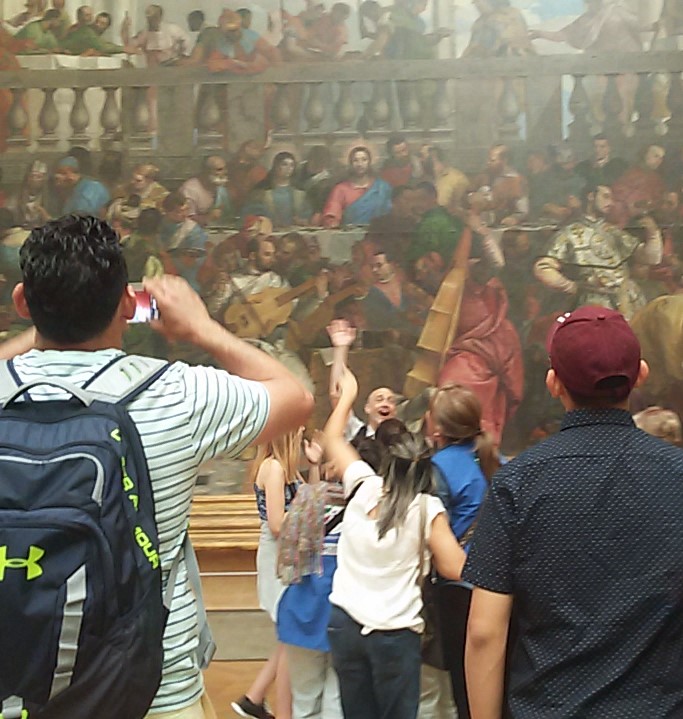
We spotted enough artworks on our list to get ourselves 110 points. The opposing family got 20 more points. This was in part because they were missing a couple of pages from their guidebook and, although they didn't find as much as we did, we elected to disregard the works on the pages they were missing from our own part of the hunt. It was also because the 14-year-old, catching the spirit of the snapshot rally, decided that he would pose as different characters in the paintings when the photos were snapped. His pose as one of the dogs in Caliari's The Wedding Feast at Cana pushed them over the top. (All I did was to wave hello from beyond the gathered crowd.)

The works that were listed in our guidebook were certainly interesting. It was downright exciting to share space with the Mona Lisa and several other works that we had only seen in textbooks or on coffee tables.

One in particular, Leonardo's St. John the Baptist, smiles like the Mona Lisa. But, unlike her smile which I have always perceived as flirtatious, John's causes him to seem bemused by the attention of the artist. He points with his right hand over his left shoulder as if to say, "You think I'm something? You ought to get a load of the guy who's coming up behind me!"

An old TV series I had watched recently on YouTube, Basil Davidson's Africa, noted that the depiction of Africans in medieval and Renaissance art had usually presented them in ways that indicate that Africans and Europeans of that era simply regarded one another as people from different parts of the world. People with dark skin are shown as authority figures and servants and everything in between. Coco decided to make the tour of the Louvre galleries something of an exploration of the Black figure in art. She found numerous examples, in 90 minutes. The following photos are not an exhaustive representation of her discoveries:

The Moor, restored in the early 1600s
by Nicolas Cordier from an ancient Roman statue

Study: Adoration of the Magi, Bernardino Luini, 1520

Study: Christ Carrying the Cross, Biagio d'Antonio, 1466

Study: Women of Algiers (Eugene Delacroix, 1834)

Sunday, July 16, 2017

Sabbatical Day 5

Friday, 9 June 2017

This was the day that included, in tours anyway, the underlying justification for including Paris on my sabbatical itinerary. Today and tomorrow would be the days crowded with tours and a comparatively tight schedule. And today's schedule, I'll tell you now, got the best of us.

By now we were getting the hang of using the Metropolitan transit system. We had used it quite effectively (though perhaps not so efficiently; you can ask me about that, sometime) on Thursday, to get to the palace of Versailles and back. Today, we took the Metro to Montmartre - a Paris neighborhood built on this curious outcropping, a hill which is the highest point in the city but which rises without any remaining geological indication. It is simply there.

Montmartre from the ascent to Sacré-Cœur
Our hotel was located in the heart of tourist territory, on boulevard Haussmann near boulevard des Italiens and surrounded by restaurants serving mostly east Asian fare - Japanese, Korean, Chinese. There was an occasional brasserie, coffee house, or other restaurant, but if we wanted French regional cuisine (like the crepes we enjoyed on Tuesday evening at a Bretagne-themed restaurant near the Pompidou, the rib steak we would consume in quantity on Saturday evening not far from the Eiffel Tower, or the croques we would have in a pinch) then we had to escape the gravity of l'Opéra.

Montmartre is more of a residential section of the city, also an enclave of artists and Bohemians. Streets are tree-lined and narrower than the boulevards near us. They contained similarly less traffic. And some portions just seemed dedicated to stairways for the sake of scaling the steep incline.

It was a cool breeze, a breath of fresh air for all three of us. And it was our first destination of the day.

Display case at Le Grenier à Pain Coulaincourt
We found our guide near the boulangerie, Le Grenier à Pain Coulaincourt (one of eleven Paris locations of Le Grenier à Pain), and were treated to a delightful bakery tour as baguettes and croissants and a variety of other breads and pastries were being prepared.

At the conclusion of the tour, we were given each a baguette and a croissant to take with us. And these we stored in my backpack so that our hands would be free for the railings and banisters necessary when we accepted the challenge of the hill's ascent. We could see Sacré-Cœur above us and decided to make our approach, fully knowing that we were expected in Montparnasse at two o'clock for our tour of Paris Noir but rejoicing in a Paris that was such a far cry from Versailles in almost every way.

Sacré-Cœur from the garden behind
The basilica of Sacré-Cœur is a wonder to behold, not only because of it being so unlikely situated atop that curious hill but because - with its domes and whitewashed exterior - it is ecclesial architecture unlike any other church in Paris. We knew that lunch might end up being our baguettes and some water from a street merchant, but such a fast would be well worth the witness.

Near the top of the hill, we realized that we were approaching from behind the basilica. Like Notre Dame, Sacré-Cœur has a small park just to its south and east. This day, there was a young father stretching after a run while his very little daughter enjoyed "tummy time" on a blanket in the grass, and some women enjoying a conversation under a vine-covered pergola. We rested for a moment on a bench in the shade of a grand old, spreading tree and made a snack of some pieces of one of our baguettes.

Recovered from our climb, we continued on to the church... which, once we circled round to the front, was ANYTHING but the idyllic, gentle setting where we had taken our tour eaten our snack. There were hawkers and street performers and so many tourists! Granted, there was also a magnificent view of the city, but there were so many distractions that, had it not been for Coco snapping photos, I think I might have abandoned the moment.

Seeing the queue in front of the church and the hew of the crowd all around, at about 12:15 we fled Sacré-Cœur, vowing someday to return to Montmartre but realizing that we were likely going to be late for the start of our Paris Noir tour.

The Metro deposited us at the Opéra. Coco was indicating by then that the heat was taking its toll, and she might not be fit for a three- to four-hour walking tour. Then, as we made our way single file down a particularly narrow stretch of sidewalk along the rue Laffitte, I at the front heard a cry and looked back about ten yards, to see Gwen seated on the curb holding her knee and rocking. Coco said, "Didn't you hear her go down?!" and sat beside her to comfort her.

I confessed that I had not heard her fall and rushed back to offer comfort and whatever first aid I might. The knee was indeed swollen, but it wasn't bleeding and didn't seem broken. My first thought was that we were going to need some ice for that knee (and, as it turned out, her hip too). My second thought was that our afternoon tour was about to be scrapped.

Coco and I gathered Gwen up. We were only about a block and a half from the hotel, and she was able with moderate assistance to limp herself there.

I sent the two of them up to the room, while I went to the bar to solicit some ice. The bartender, upon hearing the need, hurried to the kitchen and emerged with a towel which he filled without any sort of lining. I moved as swiftly as I could, to keep ahead of dripping and deliver it as much intact as I could to my injured daughter.

When I got to the room, Coco volunteered that the afternoon was not going to go as planned. She and Gwen would stay behind and entertain themselves while I raced to the Place du Panthéon.

I called ahead to our afternoon tour guide, Kevi, using my phone (down to about an 8% charge), to say that we were down to one in our group and that this one would be late. "Signal me when you reach Panthéon," he said, "and I will let you know where we are."

By the end of the call, my phone was at 4%. So, I grabbed our charging stick, turned off the phone, and plugged it into the stick as I ran to the Metro.

I needed to take the No. 9 train to get to the Panthéon. If I could catch one in the next five minutes, I might be able to arrive at Place du Panthéon before Kevi had finished his first description. But I ran straight down the nearest descent to the tracks and found myself at the No. 8. Looking on a map, it appeared as though I could catch a No. 9 just a few blocks down. I resurfaced, and hustled farther east on boulevard Haussmann - not the direction I needed to go (south), but I wanted simply to board the 9 rather than have to transfer, some distance away.

Half a mile and ten minutes later, I still hadn't found a stop for the 9. So, I went ahead and caught the 8, backtracking to the Opéra where I could transfer. By the time I was aboard the 9, it was half an hour later. There was no way to catch Kevi and the group at the Panthéon. Now, I put all my faith in the phone.

The stick wasn't lighting up the charging indicator, and it was difficult to tell whether the outflow indicator on the stick was glowing blue (as it should have been, if it was charging the phone). So, I turned on the phone to see how much charge it had. It read 8%. And now, here came my stop.

I alighted, surfaced, and walked a quarter mile or so to the Place, trying my best to remember a map I'd seen almost an hour ago and to follow street signs. Forty-five minutes late, I found the Place almost empty but certainly with no sign of a group of English-speaking people on a Paris Noir tour.

The phone now at 6%, I tapped out a message to Kevi that I had arrived and began walking around the neighborhood.

4%

A notification sounded on the phone to indicate that I had received a text message. Thank heaven! I thought. I was going to be able to find them!

The message was from Coco, reporting minutes after I'd left that my passport and wallet were still with her in the room. I had taken off the belt that contained them when settling Gwen down and applying the ice and had exited in such a flurry that I hadn't put it back on.

As quickly as I could, I put the phone in "Ultra Power Saving" mode. The screen became almost unreadable, but I thought, At least I'm going to be able to receive Kevi's reply.

No reply.

I widened my search to the next ring of blocks around the Panthéon. I saw no one, and the phone reported nothing from Kevi.

I wondered whether Ultra Power Saving mode might not only render the screen dark but might also turn off sound alarms. The sun was so bright that I decided to try one last time to turn up the brightness of the screen to see whether I'd received his reply. Power read "2%" as I went to my Messages app.

Then the screen went black.

A mix of despair and anger settled in me, with surrender too, though, but also a measure of relief that I would have more time with Coco and Gwen than the day was allowing up to now. Gradually I wended my way back to the stop for the No. 9 Metro.

Back at the room, when I plugged the phone back into its wall charger and turned it on, it immediately rang with a notification from Kevi: "We are at Luxembourg garden." That evening as I spoke with my Paris tour agent, she said, "You were probably right going back to the hotel, anyway. You'd have likely had a hard time finding him at the Garden; it's a big place."


UPDATE, 16 July
Fittingly on the evening of Bastille Day, 14 July, I had another a conversation with Julia Browne - the agent who arranged, and for a great part conceived of, the Paris Noir tour we were to have taken a little over a month ago. She said she was newly returned to Toronto after a Boston screening of her agency's new film about the tour, which had won an award for Best Documentary. Julia said that she and Kevi were corresponding, to be able to supply me with the notes they use for their tours so that I could develop a presentation for my congregation. She further offered to bring the film to St. Louis, if the church would foot the bill for her to bring it here... "Next year, though," she said. "I've already booked it for as much as I can this year."


Read all my Sabbatical 2017 postings.

Saturday, July 15, 2017

Sabbatical Day 4

Thursday, 8 June 2017

If we learned one thing, today, it is that Versailles is not our cup of tea... at all. I don't know why Coco and I didn't suspect this previously, but maybe seeing the Rick Steves episode about day trips from Paris a few days before we left caused us to doubt our perspective.

Of course, in Steves' video the Hall of Mirrors there was not teeming with thousands of tourists and schoolchildren so that you couldn't get a descent snapshot without somebody either walking through or photo bombing.

Yes, I did say schoolchildren! And now a confession: For as much as my own sensibilities may have been offended by the degree of opulence Louis XIV added to his father's hunting lodge and the way that this offense was surely hoisted on the backs of the poor of his country, my student-of-history conscience was swathed  by the fact that Versailles is today a destination for local public schools. There were fourth and fifth graders everyplace seated in groups, listening to speakers, and making drawings at Versailles! the way that Gwen's fourth grade class did for learning about the Civil War at the Jefferson Barracks Museum. Can you imagine?!

With the help of a very patient and well-mannered guide, Clothilde, whose ironic sense of humor was not our own but who nevertheless was very helpful and pleasant, we walked through the public bedchambers of the king and queen and learned that the private bedchambers were where the real action took place.

Evidently, Louis would have a ceremonial bedtime, each evening, for the sake of visiting dignitaries and guests. Once tucked in, he would nick off to a mistress's bedroom or his own. Then, in the morning he would be wakened by an attendant who would guide him back to his own bedroom again, where a ceremonial rising would be orchestrated for the same crowd... because who wouldn't want to see the Sun King set and rise with the sun itself! (It would be a wonder of creation, wouldn't it.)

The day was hot - in the 80s Fahrenheit with a northern hemisphere summer season sun (and did I mention the thousands of tourists and schoolchildren?) making the interiors simmer, despite their open windows. We found ourselves wondering that, even considering the expense, the French government has not figured out a way to air condition Louis's country residence.

We had purchased a tour of the gardens as well, but the heat - now climbing toward 90 degrees with not a cloud in the sky or a breeze - made the outdoor touring unbearable. French nobility in the 17th Century bore no love for shade trees, and the gardens at Versailles reflect that. After the first stage of the outdoor tour, we handed back our companion tourist the parasol he had loaned to Coco, and hoofed it through the palace entrance to the front. I sent Coco and Gwen to the shade of an adjoining building and - after a school group of at least forty 11-year-olds - retrieved my backpack and the lunches we had stored there, from the palace guards.

Just beyond the palace grounds, near a park where we should have gone and could have sat on benches under spreading trees rather than on a curb where we were actually seated, we had our lunches and then walked slowly back to the train.


Read all my Sabbatical 2017 postings.

Sabbatical Day 3

Wednesday, 7 June 2017

This was the day of The Big Bus and the playground.

It seems that the world's iconic cities all have some manifestation of this concept or maybe this company... It appears to me that some sightseeing company figured out that it would be lucrative both for itself and the cities to offer a form of pseudo-public transportation so that tourists could get to the iconic cities' iconic places. (At least, I know they're in Washington, DC.)

Our Paris tours agent lined up a one-day pass for each of us. It's a "hop off, hop on" service, so you pick it up at any of its stops and either take the full tour, or get off and walk around a bit, then get back on to take you to the next place or to your home base.

The three of us picked up our Big Bus at the Opera (the one with a big chandelier and a phantom in it), near our hotel, and off we went.

The tour took us to the Louvre, past several more museums, the Assemble National, Place de la Concorde, the Eiffel Tower (where I snapped this not-so-marvelous photo of a guy mowing the lawn), the Champs Elysees, Arc de Triomphe, les Invalides, and back round again to where we began.

We stayed on for the second loop until we got to (of all places) the Notre Dame Cathedral again. Some friends had tipped us off to a playground that would be around back, and we decided to take advantage of some time that would be specifically gratifying to Gwen.

There was toddler play equipment along the south side of the building, and we felt a bit worried that we had miscalculated. But at the east end, in addition to a sweet garden with a fountain, we did discover some pieces of play equipment suitable for children Gwen's age. In fact, there were some children playing on the equipment when we arrived.

They seemed to be part of an after-school child care program. Their adult monitors sat watchfully nearby - two women with snacks for the children. The young people, none of whom was older than Gwen, climbed on bars, swung on a large disk suspended between two poles, and spun on another disk that was tilted at about a 30-degree angle.

With our encouragement, Gwen climbed aboard the tilted circle, then jumped off to get it spinning when Coco wore out. One rambunctious boy lay for a time spread eagle on the disk so that others had difficulty climbing on. There was a lot of youthful negotiation in French. Eventually one of the monitors told him to go and play on another piece of equipment, so he went off to monopolize the swing.

Meanwhile, Gwen had become acquainted with some of the girls who wanted to have a conversation with her. So, she asked me over to interpret what they were saying. The monitor who had just removed the boy turned to me and said of one girl, "Elle veut savoir si votre fille voudrait etre sa copine." I said to Gwen that the girl was asking whether she would like to be her close friend.

"How do you say, 'Yes'?" Gwen asked.

"You know," I said.

"Oh, right." Then, turning to the girl, she said, "Oui." The two of them smiled.

The monitor said, "Elle s'appelle Amelie."

"Her name is Amelie," I told Gwen.

"Elle s'appelle Gwen," I told Amelie.

The next hour was sublime. Coco and I became introduced to the adult companions (and to some of the children as they came for snacks and drinks), and the children played until it was time to go.

As we walked away ourselves, Gwen said giddily, "Do you think we could come back here, tomorrow?"

"No," Coco replied, "I think we have a pretty full day at Versailles, tomorrow. I doubt we can come back then."

"I think I told Amelie that I would meet her here again, tomorrow. I only know how to say, 'Oui.'"

"That's OK," I said. "They can't expect that you'd certainly be there. We're tourists."

"But I told her I would." Both Coco and I could hear the emotion in her voice, at the thought of making a new friend and not being able to keep her.

"Honey, you'd have had to say goodbye to her eventually. That's what happens when you travel: you meet new people -"

"And then you never see them again?! That's terrible! I don't think I want to travel anymore."


Read all my Sabbatical 2017 postings.
Wednesday, July 12, 2017

Sabbatical Day 2

Tuesday, 6 June 2017

We overslept. By a lot.

Yesterday, when we checked in at our hotel, we were informed that breakfast would be served from 6:30 until 10:00 AM, in the brasserie.

By the time we heard that (about 1 in the afternoon), we had been awake for more than 20 hours and weren't expecting to sleep for at least ten more. When we settled into bed, around 9:30, we allowed jet lag to overtake us, and down deep we went.

We all got up when Coco suddenly announced that it was 10:20 AM. Rather than fly about and rush down and beg for the brasserie to keep breakfast out for us, we elected to prepare more slowly for the day and stop at a coffee shop for a breakfasty snack and then have an early-ish lunch somewhere closer to the sights.

We walked to Costa Coffee and ordered a couple of lattes for the adults and a cocoa for Gwen. Pastries included a cinnamon roll that Coco and I would share, and a piece of what appeared to be coffee cake with a pale lavender frosting by which Gwen was especially intrigued.

The coffee cake turned out to be flavored with lavender, and the child only picked at it. Mom and Dad offered the remainder of their cinnamon roll to her when they saw that she wasn't much interested in what she had (either the cake or the cocoa, which came without whipped cream and "tasted more like dark chocolate than milk chocolate").

Thus began a long walking day. The long walk would start at the Costa Coffee on boulevard des Italiens and eventually meander its way south from there to Ile de la Cite.

We found a macaroon-seller for Gwen.


And discovered that "Gwen" is a prominent syllable in many words from the region of Brittany. Many creperies have "Gwen" in their names. For example,


Le cathedral de Notre-Dame de Paris rendered us all amazed. Even Gwen stated how impressed she was. She said she wanted to climb the north tower, to view the gargoyles and see out from the top, which is something for which you can buy a ticket and do.

It was 3 o'clock or so when we stepped in line to tour the nave and chapels (free). We commiserated with a couple of English tourists about the chill. A shower that had been brewing in the northwest for a time now rumbled, and the line moved markedly faster due apparently to some leniency on the part of security officers sympathetic to our worry about lightning and rain.

By 3:30 we were inside and viewing displays about the meaning and purpose of the chapels and rose windows, and the development of the cathedral.

Each chapel, as I recall, had a stand for votive candles with a suggested donation of two euros. Gwen asked to light a candle, and we said yes, knowing why.

Just four days before, we had been to a vigil outside the home of a schoolmate of Gwen's. The little girl, a kindergartner who was scheduled to enter first grade this fall, had her life interrupted by gunfire. Her mother, father, and younger sister were in the car with her. There was no known motive behind the decision by a man to approach their car and another and to fire into them, killing the driver of the other car and the girl's mother and father. She suffered a bullet wound to the head; her sister was not shot. On Saturday night we responded to a call to prayer and testimony. We wrote cards of greeting and hope to the girl and her extended family, lighted candles, and set our prayers aloft accompanied by helium balloons. The memory was still fresh.
Our candle with others, June 6
The vigil, June 2: "GWS" - Get Well Soon
"DMI" are the girl's initials


At 4:15 or so, Coco elected to sit in the nave while Gwen and I would go up the north tower. As we walked with Coco, an announcement in French came over the public address system, but my command of French is not so good as to have understood it. I figured that it was something about hours of closure or an upcoming mass.

When we started toward our exit, police officers in Kevlar approached and ordered us to be seated in the nave - all three of us. No one, they said, would be allowed outside. That much French I understood. I think anxiety may help with comprehension.

Next, we heard sirens and at least imagined we heard a gunshot or two. Gwen asked what was going on, and Coco and I (as calmly as we could) said that we didn't know but that the police officers did know and were directing us to be seated. Because police are always interested in our safety, we said, we should do as they said and wait patiently until they would say it was OK to go outside again.

Police watch over the crowd.
There ensued two hours of being seated in the nave of Notre Dame. Fully twenty minutes of that time was spent with our hands in the air or on our heads as police observed the crowd, in order to discern, we assume, whether any of us were connected with the unnamed event that had occurred outside.

Police communicated instructions and encouragement through two priests who translated the messages into English, Spanish, and Italian. At 6:00 PM, which I assume was the time when a mass would have otherwise been occurring there, the priests led us in praying the Our Father and the Hail, Mary, first in French then in English, as well as prayers of petition and intercession. It was a strangely peaceful period during an otherwise troubling afternoon.

At about 6:45 we finally were told by the priests that the police would release each section row by row. One tour group immediately rose with their guide and attempted to assume a new, closer position in the queue. Police did their best to return them to their places, but to little avail.
They could not watch everyone always, and our withering looks usually went unregarded. Gwen was wroth with this, especially because she knew her mother needed to use a restroom and now would be forced to wait longer as a result of these opportunists!

Finally, we emerged, after being questioned individually whether we had seen anything outside. "Non," each of us told them.

Police in flak jackets and carrying automatic weapons lined our walk away from the cathedral. They weren't as reassuring a sight as I presume they had hoped to be for us, but I admit a bit of satisfaction in seeing some members of the opportunist tour group detained for having tried to slip past barriers and find their own way back. No handcuffs, but a firm talking-to in French to a crew whom I assume understood not a word.

According to Gwen's concern, our objective by this time was to find the swiftest route to a restroom. Just across the nearest pont we spotted one of the free, self-cleaning lavatories. There was another family waiting... and a man who seemed rather peeved. In fact, he was a little too peeved. And the dad of the family, who were audibly Americans, was facing the guy down as to who was going to go next into the public privy.

It became clear that this was not the place where we wanted to stop for ourselves, but we slowly walked away when we saw the American Dad shout his way past the somewhat-off-kilter native and press the button to shut the door. "I'm not sure he thought that through," said Coco, as we both realized that Mom and their two young children were left outside the restroom with the other fellow raving at them.

Throwing his arms up in the air and continuing his rant directly at Mom, the irritated one eventually walked away, shouting occasionally over his shoulder. We couldn't be sure what kept Dad inside, but we assumed that there must have been some serious intestinal matter afflicting him, for him to have enclosed himself and isolated his family so hastily.

We continued on and, a few minutes later, found relief at another comfort station. Interestingly, we saw the angry man grumbling at another group on a street corner just beyond the brasserie where we sat down for dinner. He didn't appear to recognize us, though it seemed as if he noticed my gaze at one point.


Read all my Sabbatical 2017 postings.

Sunday, June 11, 2017

Sabbatical Day 1, Day 7

This is now the seventh day I've been in Paris with my family. Until now, we have had a busy enough schedule that I haven't had time to publish any blog posts. I've been keeping notes, believe me. But have I been able to sit long enough at a stretch to actually publish anything? Not so much, so far.

Plus, there's the matter of not being able to sign onto the church website from France, or probably anywhere other than the States, to post new entries. That's the reason why you're finding this, here.

Sunday, 11 June 2017

So, today is special. It's Sunday, and we've spent the day getting ready to travel again - learning the ins and outs of Paris coin laundry. Tomorrow morning at 7:15, our driver arrives to take us back to Charles deGaulle Airport.

We have a flight out at 10:30am which will deliver us for the afternoon, to London - Heathrow. That will provide our connection to Accra, Ghana, where we will arrive at 7:30 in the evening.

Although we've spent a week at a latitude where the sun doesn't set until almost 10 o'clock, and the sky is still light until 11, tomorrow it will be dark at 7:30. So, we'll travel from the airport to the Coconut Grove Beach Resort in Elmina under the pall of night.

For the next four days, we'll have a chance to relax after such a rich cultural experience here, for me to reflect here... and pick up with our pilgrimage where it got left, this past Monday.

On Monday, 5 June, we were welcomed to Paris by Shannon, who is the daughter of Julia Browne, founder of Walking the Spirit Tours. Shannon noted that my family and I were here, especially to enjoy a walking tour of "Black Paris." Paris was the home of many African American intellectuals, entertainers, and artists, as well as military personnel and some folk who just wanted to be treated like human beings, during the first half of the 20th Century.

The group included musicians, especially jazz musicians, and the sounds of jazz waft out of restaurants and brasseries everywhere as you pass them. In fact, the lobby of the hotel where we have been staying has a 24-hour repetition of jazz standards by such luminaries as Louis Armstrong, Duke Ellington, Ella Fitzgerald, Lionel Hampton, and Miles Davis. You might guess that this same French (or at least Parisian) fascination with jazz continues in clubs and other venues all over town.

Adventurers, intellectuals, authors, poets, entertainers, and artists also took advantage of the relative freedom they experienced in Paris, unlike the persistence of humiliation and segregation they found in their home country. The list includes Eugene Bullard, Ada "Bricktop" Smith, Countee Cullen, Richard Wright, Chester Himes, James Baldwin, Nina Simone. W. E. B. DuBois in 1919 chose Paris as the location for the first in his series of Pan-African Congresses, which would usher in the movements for independence across Africa and initiate the post-colonial era.

During Shannon's introduction of Paris, as we were talking about getting around the city, she said that she hoped we would enjoy our Black Paris tour on Friday. She mentioned Place Josephine Baker, where the tour was scheduled to begin, in the shadow of Tour Montparnasse. She asked Gwen whether I had told her about Josephine Baker, who was a native of Saint Louis. When Gwen demurred, I volunteered that Gwen had been in the room when I was watching a video about Josephine, but said that I thought somehow Gwen had missed the Banana Dance.

Shannon said that she hoped Gwen would watch Josephine dance, sometime, especially the Banana Dance, for which Josephine would don a skirt made of bananas... and little else. Shannon said, "She would dance in ways that would be very sexy and then she would strike poses and make faces that were very silly. Often people didn't know what to think of her because she did that, but they were fascinated and excited because of the way she performed."

Gwen seemed unimpressed. Maybe it was her lack of sleep, just then. Maybe it is that she's not quite done with being 10 years old. After all, she spent much of the week shocked at how many public displays of affection she saw, and lingering displays at that! And people smoking, she is definitely not pleased with the prevalence of cigarettes in Paris.

Anyway, she definitely came for the Eiffel Tower. I came for Black Paris. "Why are you so interested in that?" Shannon would eventually ask. "Because I have an almost obsessive, vested interest in knowing how and where African Americans are, or have been, feeling successful and blessed," I answered.


Saturday, October 8, 2016

Ambivalence

In the past three years, I think I have been beginning to gain a foothold on the ambivalence of the apostle Paul about the faith communities with which he corresponded throughout the third quarter of the First Century.

This is not a foothold I wanted or sought.

Aware of my passion for justice and my activist heart, I have been invited repeatedly to take roles of leadership in the interest of bringing peace with justice to different settings - communities and country. I have been in attendance at meetings between clergy and community leaders with the governor of my state, chiefs of police, mayors and other highly placed officials. My mainstream (white, married, male, heterosexual, middle class, parent...) presence has helped to ensure that the variety of minority communities concerned about the implications of the killing of Michael Brown by a Ferguson police officer are reinforced by equally concerned majority members of society.

We must not forget. We must never forget: Eighteen years old and African American, Michael was unarmed as shots rang out. He was struck multiple times and killed by Officer Darren Wilson with whom he had struggled earlier. Dead and uncovered, Michael's body was left lying in the street for nearly four and a half hours for all to see. Whether intended or not, the Ferguson Police Department by leaving his body so exposed appeared to make Michael an example for others who might dare to defy authority. The scene rang familiar for many who declared that it resembled a Southern-style lynching or a Roman-style crucifixion. Michael's name has been added to a seemingly endless roster of African American men and women prevented from realizing the fullness of promise within them.

My wife and I have lamented his death and the growing amount of blood being spilled and muddying the steep trail towards equality and unity. Coco posted then on Facebook,
"How young is young enough to teach Gwen to be guarded around white folks? Praying for peace in Ferguson."
I confessed in a sermon once that I had wished when Gwen was born that Americans as a people might have finally erased, by the time she was old enough to understand the words of W. E. B. DuBois, the "color line" he so poignantly described at the turn of the 20th Century.

But it hasn't. If anything, its clarity is sharper now than ever. And in an era in which our younger generations clearly will choose to disregard color or sexual orientation when judging a person, it is sickening that there is still enough racism left in us to fill the killing of so many people with souring overtones.

I want to cry out, to call for justice. And repeatedly I have been invited to do just that.

This much, however, weighs in the balance: I am my daughter's father, while at the same time I am also the pastor of a police officer who has been called up for duty, keeping the peace in Ferguson during these wakeful nights there.

I know, at least second hand, the delicate balance of protecting and serving. Law enforcement can be a maddening profession. "The quality of mercy," as Shakespeare referred to the problem of executing the law, may be "not strained," but the administration of justice certainly can be. And here we have one of those strained moments.

And I am the pastor of dear friends of the grandparents of Darren Wilson, that same couple who reared him from his earliest years into the man he became. The grandparents and my parishioners were out to dinner together when Officer Wilson called from an emergency room to say that he had been involved in an encounter which had ended in the death of a young man he had shot.

There is not a fiber of my being that believes any American police officer would presume to join the force encumbered with a racist heart or imagination. With the purest of intentions, they expect to protect and to serve. The blindfolded character of justice is presented in that way to assure the balance of the scales she holds. Every individual in law enforcement I have ever known has entered the field with the personal expectation that she or he will exercise that measure of equanimity.

And we citizens expect no less of them. We want no one citizen afforded greater deference than any other. All ought to be able to expect treatment with respect and dignity.

Then a moment comes to pass like the one that Saturday afternoon in Ferguson, and so many times before and since. Fear or passion or rage or haste escalate as divisions we imagined we individually had overcome prove insuperable, because our society still has a very long way to go toward the defeat of prejudice and fear of one another. Heated words may be exchanged, the situation may come to blows. The gentleness and kindness to which we are called in the Christian tradition do not prevail, and principled people descend into the hell we sometimes make of earth rather than the heaven to which the Almighty beckons us.

Two thousand years since Paul wrote his letters, we still witness how Paul loved the people to whom he wrote, and the ambivalence he felt about them because he loved them.

The opening of nearly every one of his letters includes almost fawning praise for them. But it never took long for him to turn from praise to preaching. In the first letter to the Christians at Corinth, Paul described groups with different dietary restrictions, and mysterious categories of "weak" and "strong" adherents the precise qualities of which we no longer comprehend. He cursed at the Galatians for confusing the gospel with its messengers. Later letters indicated that there were in some among the Christians who sought to undermine or even overthrow their rulers, perhaps because of the freedom they had come to know in Christ, and Paul would offered warnings about keeping in line with authorities, presumably to keep his own religious minority safe (Romans 13).

For one curious hallmark of Christian communities in ancient Asia Minor and Greece seems to have been their attractiveness to a wide variety of humanity. As Paul would put it in one letter, those churches included not only male and female, but "Greek and Jew, ... barbarian, Scythian, slave and free" (Colossians 3:11). And these would have difficulty getting along, even in the uniting love of the Holy Spirit.

I love my parishioners and never want them to imagine that I somehow disrespect them or trivialize their professions or ignore their struggles. I bear within me the heart of an activist and the concern of a pastor. I find these better selves within me at odds with each other. In the same moment as my conscience insists that I must demand justice, for the sake of my daughter and my brothers and sisters who also are Black; my Christian heart and pastor's role insist I must extend mercy to those charged with keeping the peace in places where injustice seems very visible. I must be compassionate toward both at once.

It is this sort of concern which confuses the heart. And isn't this ambivalence like what Paul must have been feeling when he saw his churches divided over rights and privileges, and then asserted (perhaps fatalistically) that he had to be "all things to all people"!