Showing posts with label interfaith power and light. Show all posts

Monday, March 3, 2014

New Old Ways

A sermon by the Rev. David Denoon, delivered February 16, 2014
For audio, listen here 
For the February 16 order of worship, including links to the scriptures described, click here.

The title of this sermon is “New Old Ways,” and in it I have tried to capture how it was that Jesus would take a commandment and reframe it. “You have heard it said... but now I tell you...” He wasn’t rewriting the Law when he did this, he was trying to help people to look anew at things they might be taking for granted. He was saying that you might follow the letter of the law, while missing entirely its spirit.

You cannot take seriously the warning against murder unless you also take seriously the thoughts of cruelty that reside in you. You cannot possibly be taking the prohibition against adultery seriously if you objectify others and exploit them for your own gratification or gain. If you want people to take your word seriously, then be straightforward. Say what you mean and mean what you say.

The Law doesn’t have to do with you, except in as much as it has to do with how you treat others... and, by the way, how you treat the world around you.
IPL logo

Today is the Sunday of the Interfaith Power & Light Environmental Preach-In. For those of you who aren’t acquainted with Interfaith Power and Light, it is a nationwide organization that has been at work for the past few years, encouraging people of faith toward more conscientious
environmental stewardship.

Now, by my taking part in the Preach-In, it may be expected of me – by them or maybe by you – that I should come out espousing some particular issue of the day in order to promote our world’s natural well-being. In fact, I have little doubt, given the emails that I have been receiving from IPL lately, that they would really like for me to find a way to say that scripture warns us against such a project as the Keystone XL Pipeline. And maybe that is what scripture does, but (as you might have guessed, in consideration of our text today that has Jesus saying there’s more to the Law than simply following the Law) there’s more to environmental stewardship than any single environmental issue. You know?

Ignore the argument over environmental impact.  Consider the perceived need for any such pipeline to exist.

Our culture and our economy demand that we be mobile, and that mobility is dependent upon fossil fuel. What can we do personally to diminish that dependency while still being mobile? Use vehicles that are more fuel efficient.

Is a lighter, smaller car the way to go for fuel efficiency, or should it be a hybrid of gas and electric, or should it be electric altogether? Because if it’s the last of those, the fact is that even though you’re not burning fuel with the car itself, either (a) a power plant is burning fuel to generate the electricity from which the batteries are charged, or (b) a hydroelectric plant is damming a river in order to generate the electricity for the batteries. Either of those impacts the environment.

And then there’s the matter of the batteries and the hazardous waste they will create when someday you have to part with that car and relegate it to a slag heap. Then, not only your third option seems rather unattractive, but your second one as well – the hybrid vehicle. So, now you’re back to the matter of fuel efficiency again and trying to optimize your miles per gallon of gas with a strictly internal combustion engine.

Given the performance of most hybrid vehicles, the question arises whether it’s not better to make a car lighter and more aerodynamic. Except that now we’re back in the realm of talking about whether or not the Keystone XL Pipeline is something to do with or without, just like all those oil rigs proposed for public lands and already pumping and shipping oil through our coastal waters. And God knows we don’t want another Exxon Valdez or Deepwater Horizon.

Furthermore, there is already too much carbon dioxide in the atmosphere; global warming seems mostly to be the result of our consumption of fossil fuels.

Anyway, the sensation often is that we’re certainly damned if we don’t try to change our lives and lifestyles and livelihoods, and that we may be equally as damned if we do nothing about them. How can we choose the life that Moses in Deuteronomy encouraged his people to choose, when it seems as though every choice before us brings death?

It’s time to reframe the question, I think. But I have no idea myself how to do it. I count on scientists to be brilliant and to generate the necessary technology and innovation to make our engagement with the world better.

In the UCC, today is also Science, Faith, and Technology Sunday, so it seems fitting to look at our stewardly predicament from the viewpoint of a couple of scientists.

One scientist considers religion irrelevant to address the problems of the world, anyway, and may challenge therefore my use of his thinking. The other saw the conjunction of faith and science as a beautiful synthesis. But both of them have been possessed of such a respectably visionary pragmatism that I just can’t come up with a better direction to go. The two I am thinking of are George Washington Carver and Neil DeGrasse Tyson.

Reading an article about Tyson recently, I found myself reminded of Carver.  Neil DeGrasse Tyson grew up in the Bronx, and as a city boy first saw the stars only thanks to a visit to the Hayden Planetarium, of which he is now the executive director. George Washington Carver developed a fascination for fruitful gardening growing up on a farm near Neosho, Missouri. Thus, each knew what he wanted to do, from the time they were boys. And they have done their work, with vision yes but moreover with pragmatism.
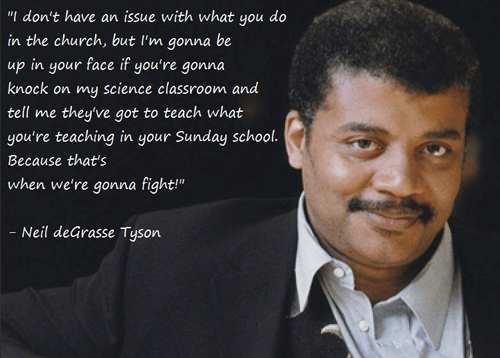
Dr. Tyson has consistently endeavored to make hay while the sun has been shining, promoting the sciences – especially his own field of astrophysics – as means by which new discoveries may be made which will have effects for making our lives better.

Along the way, he’s been invited to try and inspire our government to sponsor an expedition to Mars. His reply has been to ask, Why should we go? And the answer has come, of course, We’re a species of explorers; that’s what we do.  We want to find out new things. We go for the sake of science.  But Dr. Tyson knows that this is not the reason why most people would want to go to Mars, not if it’s going to be something more than a stunt.  A mission to Mars has to be a good financial investment. If an expedition to Mars is not a sound investment then the reasons for going probably aren’t so well-advised. Because we’ll stop. We need to have a persistent, vested interest in going, if we are going at all.

Brilliant.

Dr. Carver recognized the need to restore the soils of the South which had been depleted through plantation farming – a single crop set in the same soil year after year.  People were exploiting other people and exploiting the earth in ways that were killing both. Seeing that cotton could not continue to be grown as it had been, Dr. Carver promoted yam and peanut farming. He famously came up with a whole host of uses for the peanut, but less famously came up with new means of cultivation and crop rotation for the sake of replenishing the soil. He promoted farms with a variety of crops instead of plantations and one-crop farming.

One author suggests that Carver was promoting principles at the turn of the 20th Century that were developed by another researcher in the 1940s into procedures that would eventually form the basis of organic farming.  And he did all of this with an intensely Christian orientation:
[In speeches he would argue] that the principle of unkindness as injustice and of kindness as trying “to assist you in every way that I can… to do my very best for you” applied “with equal force to the soil. The farmer,” he explained, “whose soil produces less every year, is unkind to it;… a soil robber,… robbing it of some substance it must have.” (The Carver Story: The Agriculturist)

You shall not murder.
You shall not commit adultery.
You shall not bear false witness.

These commandments instruct us, according to Jesus, not only that doing these things is against what God would have us do. They tell us that they are neither in our nor in the other person’s interest, against whom we commit the sin.

God’s Law provides a warning against being sociopaths, against treating another individual as a means to an end, against practicing powers that ought to belong to God alone. Any one of these things is an abuse of another or an abuse of society’s established order. So, Jesus takes the commandments to their logical extreme, saying effectively, Don’t just abide by the letter of the Law. Seek to comprehend its Spirit. As Moses said far more simply of the Law, Choose life. These are the ways of Life.

As few others have done, in the examples of Drs. Tyson and Carver there is no denying that they have elected to be directed not by the demands of others, not by cultural expectations, but by the paths they have seen which will encourage others to embrace life as fully as possible. Neil DeGrasse Tyson regularly seeks to blow the minds of his audiences, and to help young people to imagine grander possibilities for themselves. He is the only astrophysicist I know who can Moonwalk, and that is a discipline he jokingly insists that other astrophysicists need to learn, to be true to themselves and their calling...


George Washington Carver practically reinvented farming and along the way sought to reorient a religion which had diminished itself into a narrow-minded myth factory – defending its surrounding culture and the hatred inherent to it. For hatred will justify murder and adultery and false witness, unkindness of all kinds.

If we are to be for the world what is needed by the world, if we are to be the stewards that we are called to be, then we know what there is to do: to imagine new ways to practice our stewardship of the world and responsibility to each other, new ways that will have long-term effects and commitments.  We need to choose life for ourselves and to treat one another with respect, indicating that we have reverence for all people, for ourselves, and for the earth.

And all of that may have something to do with pipelines and too much carbon in the atmosphere and acidifying oceans and reducing fossil fuel consumption. But I’ll admit that mostly it has to do with adjusting our focus and inviting others to do so as well. So that old ways may be renewed... and old hearts renewed... and old minds refreshed... and old lives reborn.

Amen.

Sunday, February 10, 2013

Bearing the Glow

A sermon by the Rev. David Denoon for Boy Scout Sunday, February 10, 2013
An audio version of this sermon is available.
A video about our Boy Scout Sunday by Wade Smith of Channel 2 News is available.

SCRIPTURES FOR TRANSFIGURATION SUNDAY

I can’t tell you the number of ministers I knew in 2009 and 2010 who used Susan Boyle as a comparison for transfiguration, when she sang her way to the top of the competition in the television contest, Britain’s Got Talent.  Homely in appearance when she took the stage, Ms. Boyle had a clarity of vocal tone and timbre that absolutely stunned her judges and a worldwide audience.  She shone with a glory few would have imagined, based on appearance.

The story was heartwarming, but versions of it happen quite a lot.  The question is, sometimes, whether the Glowing One will be able to bear shining for long.  We all have our encumbrances.  But there is such potential!

One imagines that Jesus’ disciples had their high moments and their low ones.  In the story earlier in Luke, when Jesus makes apostles of seventy of them and sends them abroad into Galilee, they return with exciting tales of their successes, cures, and blessings (Luke 10).  But when Jesus descends Mount Hermon, he finds them impotent before the challenge of a poor, raving boy.

"The Transfiguration"
from the Jesus Mafa series
All Christians stand in the glorious light of Christ’s transfiguration, the brilliance of Jesus’ glowing from the mountaintop. We emulate as well humility similar to that of the apostles, as they try to figure out what to do about it... because we like them have found ourselves glowing too, have known our shining moments, just like them.  And we therefore also have found ourselves commissioned with a powerful and power-filled message.  And (surprise! surprise!) we can be intimidated by the message that we have to carry forward, however – a message of peace and justice and wholeness and life.

What? Little ol’ me?

If we are puzzled by what we ought to do next, or just what we ought to do, then my advice would be simply for us to consider what Jesus’ first action was after the Transfiguration: he healed a boy.  He found his disciples intimidated or overwhelmed by the task of providing care so he jumped in and did it.  And this, like all of Christ’s works, may seem as though they were accomplished fairly quickly and completely, all at once.

The temptation in our modern world always seems to be to rush things, to expect immediate results.  We have gotten too used to pushing a button and having an outcome immediately.  We have grown too accustomed to waiting thirty minutes, at the most three hours if it’s a sporting event, and to be able at the end of that relatively brief span of time to know who emerges victorious or at least to witness how everything plays out.

It’s important to remember in our day and age that, there on the top of Mt. Hermon, or wherever this hill is near Caesarea Philippi in the Galilee, God through Christ had been putting things in place for at least a year and perhaps for almost three years. (That estimate of time comes if you read Mark’s version of the Transfiguration; if you read Matthew’s or Luke’s it’s been more like a thirty-year wait, since Jesus’ birth. And if you read John, which has no Transfiguration story but definitely bears an opinion about God had been stirring the pot and preparing the world for the Messiah since the beginning of time.  For John, as for most Christians since John was written, the dark day on another hill near Jerusalem would have as part of it not only the cross of Calvary but the crux of history.)

Moses was on Mt. Sinai for eighty days and nights before his face began glowing... and didn’t stop.  For God, a Psalmist once said, “a thousand years are like ... yesterday.”  So, some things will take time.  And for earthly forms to show forth the glory of God, time will be taken.

Last Monday, there was word all over about some changes that the Boy Scouts might be making to their rules regarding membership and leadership.  The announcement came welcome to the ears of our congregation.  We place few restrictions on membership and leadership in our church, and we want Scouting to be on the same page with us, because it’s part of our programming and therefore part of us.

The First Congregational Church of Webster Groves has had Scouting as part of our regular programming, ever since converting our first-west-of-the-Mississippi Boys Brigade into a Boy Scout Troop.  Boys Brigade was an innovation to many Sunday Schools across the United States in the last decade or so of the 1800s, espousing the idea of ushering boys toward "Christian manliness."  It originated in Britain, however, and remained something of a British vehicle; our own charter was granted by the Boys Brigade Canadian office.

Even though Lord Baden-Powell who founded the Boy Scouts was British, there was something about the slightly-less-sectarian and much-more-outdoorsy orientation of the Scouts, undoubtedly, that appealed to us as a church.  And the fact that our Scouts could be chartered by an U.S.-based organization didn’t hurt.

Boys Brigades to this day are always attached to Christian faith communities, and those Scout troops such as ours with a legacy stretching to the days of the Boys Brigades retain that association in most cases.  Scouting is a program of this church.  We don’t acknowledge it much, and haven’t since, somewhere a long time ago, we just started taking it for granted.

First, we took for granted that it was part of us; then we sort of lost track of that fact.  For many years, we have said that we sponsored a Boy Scout troop, and in the past decade or so that is what it has seemed like, since few to none of our boys or adults have been involved with the program which has carried on, sometimes maybe despite us.  The charter you will see represented, later, is the annual permission given to us by the National Council of the Boy Scouts of America to call our boys program, Boy Scouts.  We have met their exacting standards.

It was last September or so, after discussions began among frustrated church members who had been involved with Scouting that I discovered that I had the relationship backwards, and it was therefore only then I began to understand just why my church members were so upset as to want to send a letter or stage a protest or cut ties altogether...

The Scouts’ stated restrictions about members and leaders – even for all the assurances of an at-least-implicit don’t-ask-don’t-tell policy – is problematic for a church which started a Boys Brigade in 1908 because we thought it would help our own boys negotiate the challenging waters of boyhood and adolescence, helping them focus on Christian values of faithfulness, reverence, discipline, and self-respect.  What isn’t right about that, even today, one hundred five years later?

But our concepts of faithfulness, reverence, discipline, and self-respect have changed, as from generation to generation in generations before us perspectives changed and therefore the interpretation of God’s word and will.  I am assured by some that our fairly progressive stance on who ought to be able to join or lead our own Scout troop, or any program of our church, differs from that of the National Council of the Boy Scouts only by the sum of time it will take for Scouting to catch up.  (Remember how long it took Jesus to get to that hilltop and be transfigured - a year, three years, a lifetime, or an eternity!)

This past week, we thought that it might not be decades in the sum but perhaps only years before our tension is resolved.  After all, we only took our Open and Affirming stance, five short years ago, and its process took quite a while of self-examination and education.

Our Boys Brigade was retooled in 1910 from the stance it began with in 1908.  The Scouts are focused on the outdoors and education while the Boys Brigade made no bones about training Christian spiritual soldiers.  Well, the change in perspective we would like to see come about is not much different.  And remember how long it took Jesus to get to that hilltop and be transfigured – one year, three years, thirty years, since the beginning of time!

Bearing the glow is one thing, we know, but getting to the glow is not a speedy process, ever, it seems.

There's something else that requires much time for a change in perspective or practice (glowing or abiding the shine):

Today, our local church is planning with the denomination for an Eastertide focus on environmentalism and stewardship.  In fact, if today had not been Boy Scout Sunday and the recent events in our congregation and rumoring round Scouting’s National Council had not been so timely, I probably would have been part of the national Preach-In led by Interfaith Power and Light.  This is, however, as close as I am coming to that observance – encouraging you in the tradition of our own scouts to plan to be part of the Green Team Lynda Morrison is trying to build up next Sunday with some new and motivated members.

But I was talking about glowing and what to do about it.  I have been saying, and Tracey with the kids has been saying, for the past many weeks through our innovative Sunday School curriculum, We are the body of Christ.  And that is the case, whether you assume the metaphor that we are each individually a different body part, or else the extension of the story we have heard today – that by faith you are being transfigured as Christ was, two thousand years ago on a hilltop in Galilee.

When Jesus came down off the mountaintop, unlike Moses he was no longer glowing; he looked himself again... and yet Peter, John, and James said that they had witnessed his transfigured reality. However momentarily it may have been, it was permanent in their eyes. They knew now what he was capable of.

The first act he performed after coming down off that hilltop was to heal a boy that no one else could heal.  And he insisted that all they required was a measure greater of faith, for them to do the same.  But that faith, as always in Jesus’ statements, was theirs to cultivate, theirs to believe in.

We know, don’t we, that the emanation of Christ is here and among us.  We know that we are the body of Christ, transfigured and refigured so that we may operate in the world without having to disguise who we really are.  We can provide the safe sanctuary for people who may not be harbored anywhere else safely and unconditionally.  We can provide the extravagant welcome and the beloved community that is lacking in so many other places in our world, even Christian places.  We can come down from our Galilean hilltop, our Palestinian peak, our high place in Webster Groves, and all our lofty locations and, whether inside our outside, ensure a healing environment for boys to become... what is it..?
"physically strong, mentally awake, and morally straight"