Excerpted from the sermon, "The God You Don't Know Yet" (May 25, 2014)
You know, one of the facts about the way I believe is that I keep running into the God I don’t know... or at least the God I least expected. It’s as if God has this wicked sense of humor, or else just likes to make sure I’m paying attention. “Hello, I’m over here,” God will say. And it’s true.
Some of you already know about my Tuesday, this past week. I am coming to term “my day of hugs.” During the span of that day, I was hugged by a half a dozen or so people.
This is unusual for me. I am a person on whom my very tolerant wife has learned to place low expectations about such things. Public display of affection is not something with which I have ever been particularly comfortable.
Furthermore, people in my profession of caring are warned nowadays to practice “appropriate boundaries,” which usually provide for a handshake or simple word of encouragement where otherwise a hug might do.
Thus we imagine, neither we nor the person we are greeting get the wrong impression of the gesture. Spiritual intimacy must not lead us down a destructive path.
Nevertheless, there are times when a handshake just isn’t sufficient. And three of those times were Tuesday.
Early that afternoon, I had gone to spend some time at the bedside of a member as she lay dying and, as I often do with people who are otherwise non-responsive, reached out to hold her hand. To my surprise, she took my hand in hers, then pulled it up to her chest and wrapped her other arm around mine – the best hug she could manage from a deathbed. The moment was sublime, sacred.
Not long afterward, that same day, I attended with my wife a program of readings of original poems by my daughter's first grade class at school. During the congratulations that followed, a familiar boy in the class arrived beside me. He and my daughter had been part of the group I chaperoned for a recent zoo field trip.
It was nice to be recognized, I must say. But he said nothing, just looked up and then tried to hold my hand. I gave his hand a squeeze and tried to let go, but he wouldn’t release. Then my daughter came up, and he let my hand go just long enough for me to kneel down and give her a hug, telling her of my pride and joy at her performance. Then, before I could stand back up fully, the boy folded in and hugged me too.
It was at this point that I realized neither of his parents was present. So I told him that I knew his parents were proud of him too and wished that they could be there. He squeezed tighter. After that came a little girl, a playmate of my daughter whose parents also had been absent. I told her as well how I thought she had done very well and how proud her own parents would be.
Now I started to stand up again, but the girl who was coming home with us for her and my daughter's standing Tuesday playdate stepped forward and, shrugging, said, “Well, I guess I’d better give you a hug, too.” Although her mother had been there, Dad wasn’t able to be, and Mom had returned to work. So, the process continued with her, and ended with one last hug for my daughter.
Tuesday evening, I attended my first meeting of the board of directors of the Interfaith Partnership. I was honored to be seated next to the president, a Bosnian Muslim imam who attended my installation, four years ago, and had invited me to join the board, this past winter. Toward the end of the meeting, we were discussing the recent flooding and landslides in Bosnia following the most severe rains to have happened there in more than 120 years.
There were tears in his eyes as he spoke. His family was safe, and his hometown has seen little damage. But the destruction and devastation around them are such that they despair for the work ahead. God will provide, we both said we knew, but it’s a mystery where the help will come from when even the hills are washing away. (compare Psalm 121:1)
I held him for what must have been only seconds but felt like minutes. The commensurate masculine back-patting and quiet chuckling at the end seemed as ironic to the moment as our smiles to each other for strength, as we stood together, meeting God again. I think that I was bound to bring him to that place with me, since I’d spent so much time there already, that day.
Monday, June 2, 2014

Monday, March 3, 2014
New Old Ways
A sermon by the Rev. David Denoon, delivered February 16, 2014
For audio, listen here
For the February 16 order of worship, including links to the scriptures described, click here.
The title of this sermon is “New Old Ways,” and in it I have tried to capture how it was that Jesus would take a commandment and reframe it. “You have heard it said... but now I tell you...” He wasn’t rewriting the Law when he did this, he was trying to help people to look anew at things they might be taking for granted. He was saying that you might follow the letter of the law, while missing entirely its spirit.
You cannot take seriously the warning against murder unless you also take seriously the thoughts of cruelty that reside in you. You cannot possibly be taking the prohibition against adultery seriously if you objectify others and exploit them for your own gratification or gain. If you want people to take your word seriously, then be straightforward. Say what you mean and mean what you say.
The Law doesn’t have to do with you, except in as much as it has to do with how you treat others... and, by the way, how you treat the world around you.

Today is the Sunday of the Interfaith Power & Light Environmental Preach-In. For those of you who aren’t acquainted with Interfaith Power and Light, it is a nationwide organization that has been at work for the past few years, encouraging people of faith toward more conscientious
environmental stewardship.
Now, by my taking part in the Preach-In, it may be expected of me – by them or maybe by you – that I should come out espousing some particular issue of the day in order to promote our world’s natural well-being. In fact, I have little doubt, given the emails that I have been receiving from IPL lately, that they would really like for me to find a way to say that scripture warns us against such a project as the Keystone XL Pipeline. And maybe that is what scripture does, but (as you might have guessed, in consideration of our text today that has Jesus saying there’s more to the Law than simply following the Law) there’s more to environmental stewardship than any single environmental issue. You know?
Ignore the argument over environmental impact. Consider the perceived need for any such pipeline to exist.
Our culture and our economy demand that we be mobile, and that mobility is dependent upon fossil fuel. What can we do personally to diminish that dependency while still being mobile? Use vehicles that are more fuel efficient.
Is a lighter, smaller car the way to go for fuel efficiency, or should it be a hybrid of gas and electric, or should it be electric altogether? Because if it’s the last of those, the fact is that even though you’re not burning fuel with the car itself, either (a) a power plant is burning fuel to generate the electricity from which the batteries are charged, or (b) a hydroelectric plant is damming a river in order to generate the electricity for the batteries. Either of those impacts the environment.
And then there’s the matter of the batteries and the hazardous waste they will create when someday you have to part with that car and relegate it to a slag heap. Then, not only your third option seems rather unattractive, but your second one as well – the hybrid vehicle. So, now you’re back to the matter of fuel efficiency again and trying to optimize your miles per gallon of gas with a strictly internal combustion engine.
Given the performance of most hybrid vehicles, the question arises whether it’s not better to make a car lighter and more aerodynamic. Except that now we’re back in the realm of talking about whether or not the Keystone XL Pipeline is something to do with or without, just like all those oil rigs proposed for public lands and already pumping and shipping oil through our coastal waters. And God knows we don’t want another Exxon Valdez or Deepwater Horizon.
Furthermore, there is already too much carbon dioxide in the atmosphere; global warming seems mostly to be the result of our consumption of fossil fuels.
Anyway, the sensation often is that we’re certainly damned if we don’t try to change our lives and lifestyles and livelihoods, and that we may be equally as damned if we do nothing about them. How can we choose the life that Moses in Deuteronomy encouraged his people to choose, when it seems as though every choice before us brings death?
It’s time to reframe the question, I think. But I have no idea myself how to do it. I count on scientists to be brilliant and to generate the necessary technology and innovation to make our engagement with the world better.
In the UCC, today is also Science, Faith, and Technology Sunday, so it seems fitting to look at our stewardly predicament from the viewpoint of a couple of scientists.
One scientist considers religion irrelevant to address the problems of the world, anyway, and may challenge therefore my use of his thinking. The other saw the conjunction of faith and science as a beautiful synthesis. But both of them have been possessed of such a respectably visionary pragmatism that I just can’t come up with a better direction to go. The two I am thinking of are George Washington Carver and Neil DeGrasse Tyson.
Reading an article about Tyson recently, I found myself reminded of Carver. Neil DeGrasse Tyson grew up in the Bronx, and as a city boy first saw the stars only thanks to a visit to the Hayden Planetarium, of which he is now the executive director. George Washington Carver developed a fascination for fruitful gardening growing up on a farm near Neosho, Missouri. Thus, each knew what he wanted to do, from the time they were boys. And they have done their work, with vision yes but moreover with pragmatism.
 Dr. Tyson has consistently endeavored to make hay while the sun has been shining, promoting the sciences – especially his own field of astrophysics – as means by which new discoveries may be made which will have effects for making our lives better.
Along the way, he’s been invited to try and inspire our government to sponsor an expedition to Mars. His reply has been to ask, Why should we go? And the answer has come, of course, We’re a species of explorers; that’s what we do. We want to find out new things. We go for the sake of science. But Dr. Tyson knows that this is not the reason why most people would want to go to Mars, not if it’s going to be something more than a stunt. A mission to Mars has to be a good financial investment. If an expedition to Mars is not a sound investment then the reasons for going probably aren’t so well-advised. Because we’ll stop. We need to have a persistent, vested interest in going, if we are going at all.
Brilliant.
 Dr. Carver recognized the need to restore the soils of the South which had been depleted through plantation farming – a single crop set in the same soil year after year. People were exploiting other people and exploiting the earth in ways that were killing both. Seeing that cotton could not continue to be grown as it had been, Dr. Carver promoted yam and peanut farming. He famously came up with a whole host of uses for the peanut, but less famously came up with new means of cultivation and crop rotation for the sake of replenishing the soil. He promoted farms with a variety of crops instead of plantations and one-crop farming.
 One author suggests that Carver was promoting principles at the turn of the 20th Century that were developed by another researcher in the 1940s into procedures that would eventually form the basis of organic farming. And he did all of this with an intensely Christian orientation:
These commandments instruct us, according to Jesus, not only that doing these things is against what God would have us do. They tell us that they are neither in our nor in the other person’s interest, against whom we commit the sin.
God’s Law provides a warning against being sociopaths, against treating another individual as a means to an end, against practicing powers that ought to belong to God alone. Any one of these things is an abuse of another or an abuse of society’s established order. So, Jesus takes the commandments to their logical extreme, saying effectively, Don’t just abide by the letter of the Law. Seek to comprehend its Spirit. As Moses said far more simply of the Law, Choose life. These are the ways of Life.
As few others have done, in the examples of Drs. Tyson and Carver there is no denying that they have elected to be directed not by the demands of others, not by cultural expectations, but by the paths they have seen which will encourage others to embrace life as fully as possible. Neil DeGrasse Tyson regularly seeks to blow the minds of his audiences, and to help young people to imagine grander possibilities for themselves. He is the only astrophysicist I know who can Moonwalk, and that is a discipline he jokingly insists that other astrophysicists need to learn, to be true to themselves and their calling...
George Washington Carver practically reinvented farming and along the way sought to reorient a religion which had diminished itself into a narrow-minded myth factory – defending its surrounding culture and the hatred inherent to it. For hatred will justify murder and adultery and false witness, unkindness of all kinds.
If we are to be for the world what is needed by the world, if we are to be the stewards that we are called to be, then we know what there is to do: to imagine new ways to practice our stewardship of the world and responsibility to each other, new ways that will have long-term effects and commitments. We need to choose life for ourselves and to treat one another with respect, indicating that we have reverence for all people, for ourselves, and for the earth.
And all of that may have something to do with pipelines and too much carbon in the atmosphere and acidifying oceans and reducing fossil fuel consumption. But I’ll admit that mostly it has to do with adjusting our focus and inviting others to do so as well. So that old ways may be renewed... and old hearts renewed... and old minds refreshed... and old lives reborn.
Amen.
For audio, listen here
For the February 16 order of worship, including links to the scriptures described, click here.
The title of this sermon is “New Old Ways,” and in it I have tried to capture how it was that Jesus would take a commandment and reframe it. “You have heard it said... but now I tell you...” He wasn’t rewriting the Law when he did this, he was trying to help people to look anew at things they might be taking for granted. He was saying that you might follow the letter of the law, while missing entirely its spirit.
You cannot take seriously the warning against murder unless you also take seriously the thoughts of cruelty that reside in you. You cannot possibly be taking the prohibition against adultery seriously if you objectify others and exploit them for your own gratification or gain. If you want people to take your word seriously, then be straightforward. Say what you mean and mean what you say.
The Law doesn’t have to do with you, except in as much as it has to do with how you treat others... and, by the way, how you treat the world around you.

Today is the Sunday of the Interfaith Power & Light Environmental Preach-In. For those of you who aren’t acquainted with Interfaith Power and Light, it is a nationwide organization that has been at work for the past few years, encouraging people of faith toward more conscientious
environmental stewardship.
Now, by my taking part in the Preach-In, it may be expected of me – by them or maybe by you – that I should come out espousing some particular issue of the day in order to promote our world’s natural well-being. In fact, I have little doubt, given the emails that I have been receiving from IPL lately, that they would really like for me to find a way to say that scripture warns us against such a project as the Keystone XL Pipeline. And maybe that is what scripture does, but (as you might have guessed, in consideration of our text today that has Jesus saying there’s more to the Law than simply following the Law) there’s more to environmental stewardship than any single environmental issue. You know?
Ignore the argument over environmental impact. Consider the perceived need for any such pipeline to exist.
Our culture and our economy demand that we be mobile, and that mobility is dependent upon fossil fuel. What can we do personally to diminish that dependency while still being mobile? Use vehicles that are more fuel efficient.
Is a lighter, smaller car the way to go for fuel efficiency, or should it be a hybrid of gas and electric, or should it be electric altogether? Because if it’s the last of those, the fact is that even though you’re not burning fuel with the car itself, either (a) a power plant is burning fuel to generate the electricity from which the batteries are charged, or (b) a hydroelectric plant is damming a river in order to generate the electricity for the batteries. Either of those impacts the environment.
And then there’s the matter of the batteries and the hazardous waste they will create when someday you have to part with that car and relegate it to a slag heap. Then, not only your third option seems rather unattractive, but your second one as well – the hybrid vehicle. So, now you’re back to the matter of fuel efficiency again and trying to optimize your miles per gallon of gas with a strictly internal combustion engine.
Given the performance of most hybrid vehicles, the question arises whether it’s not better to make a car lighter and more aerodynamic. Except that now we’re back in the realm of talking about whether or not the Keystone XL Pipeline is something to do with or without, just like all those oil rigs proposed for public lands and already pumping and shipping oil through our coastal waters. And God knows we don’t want another Exxon Valdez or Deepwater Horizon.
Furthermore, there is already too much carbon dioxide in the atmosphere; global warming seems mostly to be the result of our consumption of fossil fuels.
Anyway, the sensation often is that we’re certainly damned if we don’t try to change our lives and lifestyles and livelihoods, and that we may be equally as damned if we do nothing about them. How can we choose the life that Moses in Deuteronomy encouraged his people to choose, when it seems as though every choice before us brings death?
It’s time to reframe the question, I think. But I have no idea myself how to do it. I count on scientists to be brilliant and to generate the necessary technology and innovation to make our engagement with the world better.
In the UCC, today is also Science, Faith, and Technology Sunday, so it seems fitting to look at our stewardly predicament from the viewpoint of a couple of scientists.
One scientist considers religion irrelevant to address the problems of the world, anyway, and may challenge therefore my use of his thinking. The other saw the conjunction of faith and science as a beautiful synthesis. But both of them have been possessed of such a respectably visionary pragmatism that I just can’t come up with a better direction to go. The two I am thinking of are George Washington Carver and Neil DeGrasse Tyson.
Reading an article about Tyson recently, I found myself reminded of Carver. Neil DeGrasse Tyson grew up in the Bronx, and as a city boy first saw the stars only thanks to a visit to the Hayden Planetarium, of which he is now the executive director. George Washington Carver developed a fascination for fruitful gardening growing up on a farm near Neosho, Missouri. Thus, each knew what he wanted to do, from the time they were boys. And they have done their work, with vision yes but moreover with pragmatism.
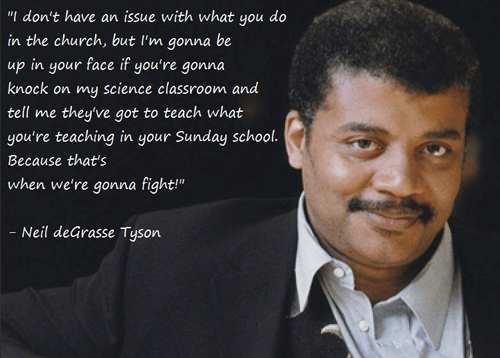
Along the way, he’s been invited to try and inspire our government to sponsor an expedition to Mars. His reply has been to ask, Why should we go? And the answer has come, of course, We’re a species of explorers; that’s what we do. We want to find out new things. We go for the sake of science. But Dr. Tyson knows that this is not the reason why most people would want to go to Mars, not if it’s going to be something more than a stunt. A mission to Mars has to be a good financial investment. If an expedition to Mars is not a sound investment then the reasons for going probably aren’t so well-advised. Because we’ll stop. We need to have a persistent, vested interest in going, if we are going at all.
Brilliant.


[In speeches he would argue] that the principle of unkindness as injustice and of kindness as trying “to assist you in every way that I can… to do my very best for you” applied “with equal force to the soil. The farmer,” he explained, “whose soil produces less every year, is unkind to it;… a soil robber,… robbing it of some substance it must have.” (The Carver Story: The Agriculturist)
You shall not murder.
You shall not commit adultery.
You shall not bear false witness.
These commandments instruct us, according to Jesus, not only that doing these things is against what God would have us do. They tell us that they are neither in our nor in the other person’s interest, against whom we commit the sin.
God’s Law provides a warning against being sociopaths, against treating another individual as a means to an end, against practicing powers that ought to belong to God alone. Any one of these things is an abuse of another or an abuse of society’s established order. So, Jesus takes the commandments to their logical extreme, saying effectively, Don’t just abide by the letter of the Law. Seek to comprehend its Spirit. As Moses said far more simply of the Law, Choose life. These are the ways of Life.
As few others have done, in the examples of Drs. Tyson and Carver there is no denying that they have elected to be directed not by the demands of others, not by cultural expectations, but by the paths they have seen which will encourage others to embrace life as fully as possible. Neil DeGrasse Tyson regularly seeks to blow the minds of his audiences, and to help young people to imagine grander possibilities for themselves. He is the only astrophysicist I know who can Moonwalk, and that is a discipline he jokingly insists that other astrophysicists need to learn, to be true to themselves and their calling...
If we are to be for the world what is needed by the world, if we are to be the stewards that we are called to be, then we know what there is to do: to imagine new ways to practice our stewardship of the world and responsibility to each other, new ways that will have long-term effects and commitments. We need to choose life for ourselves and to treat one another with respect, indicating that we have reverence for all people, for ourselves, and for the earth.
And all of that may have something to do with pipelines and too much carbon in the atmosphere and acidifying oceans and reducing fossil fuel consumption. But I’ll admit that mostly it has to do with adjusting our focus and inviting others to do so as well. So that old ways may be renewed... and old hearts renewed... and old minds refreshed... and old lives reborn.
Amen.
Wednesday, July 24, 2013
AN OPEN LETTER TO ROBERT SPENCER OF JIHADWATCH.COM...
Dear Mr. Spencer,

Having read your weblog’s "About" page, I am now
acquainted with your clear and admirable opposition to jihad theology, though
not to the religion of Islam, itself. Previously, I was unacquainted with your
voice or cause. But in the last 48 hours, my church’s office administrator and
I have received a series of protest messages from readers of your blog, based
on your July 21 post which features a photo of our church signboard with a seasonal greeting in it. We are now, of course, more than well-acquainted with
you… and some of your apparent devotees.
Please be assured, Mr. Spencer, that not only I but my
friends across the religious landscape agree with you in your opposition to jihad theology. In particular, I venture to say that my Muslim friends agree
with you strongly in this regard. They and I have had numerous conversations
about the blasphemy practiced by militants who pervert the meaning of jihad,
that great spiritual struggle which is so common to our religions. I tell you
nothing new when I identify jihad as the wrestling of the faithful person with
doubt, despair, and the discipline required to maintain a life of faith. It is never
holy war with others but only with oneself.
Christianity, as you know, has many examples of the
misapplication of our principles and beliefs which resulted in
violence toward innocents and some death as well. My own religious tradition within Christianity offers
numerous illustrations of this sinful application of religion as a defense for
intolerance and cruelty. So, it is reassuring for me to discover your stated, common
purpose with our own, of encouraging dialogue and cooperation.
In keeping with our common purpose, let me assure you, the greeting is not one way, as you presume. Our church’s most recent signboard message was composed, preliminary to
the announcement of an iftar we would host with a nearby Muslim faith
community. Unfortunately, this traditional breaking of the daily fast could not be scheduled during Ramadan as
needed and will be replaced by another time together in the near future. Your “fine”
support of our attempt to increase interfaith conversation is much appreciated,
even if you do seem a bit doubtful about our potential for success.
For example, although you begin with saying, “This is
just fine,” you mitigate your congratulations, with your conclusion:
Since Muslims consider the
Christian confession of the divinity of Christ to be an unacceptable
association of a partner with God, this verse is saying that the “common word”
that Muslims and the People of the Book should agree on is that Christians should
discard one of the central tenets of their faith and essentially become
Muslims. Not a promising basis for an honest and mutually respectful dialogue
of equals.
These are very cautious words on your part. I appreciate your concern.
Since you do
not know us yet, and we are only just becoming acquainted with you, please
allow me to say that I do hope that you do not by your conclusion indicate any genuine disrespect for
the “common word” between Christians and Muslims which we are attempting to
engage.
Surely you know, the purpose of interfaith discussion cannot
be to reach an agreement on every point discussed, nor to convert the infidel, but to conduct that “honest and
mutually respectful dialogue” you clearly crave.
For if we are to live together, and we must learn to live
together, it will be necessary as well for us to find new ground on which to
live, the renewing ground of respect and cooperation. Religious absolutism
cannot be an option.
Thank you again for your endorsement
of our work, albeit an endorsement with qualifiers. Please be assured that we do not approach our interfaith partnerships naively or without
appropriate discernment. We are intelligent people and realistic ones, and we respect the intelligence and realism of our partners.
Please receive my encouragement for your efforts with my
church’s own toward changing perspectives and affecting lives and hearts of enemy,
stranger, neighbor, and friend.
Very sincerely,
Rev. David Denoon, Pastor
First Congregational Church of Webster Groves
Sunday, March 3, 2013
The Mystery of Singbe Pieh
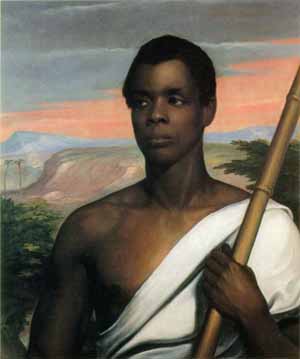 |
| Singbe Pieh |
For audio, listen here (delivered extemporaneously).
References - Luke 13:1-9; “Black Agency, in the Amistad Uprising: Or, You’ve Taken Our Cinqué and Gone – Schindler, Morphed into John Quincy Adams, Rescues Africans — a Retrograde Film Denies Black Agency and Intelligence, Misses What Really Happened, and Returns to the Conservative Themes of the Fifties; with an Account of What Really Happened, and a Few Words about Abolitionists as Fanatics.” By Jesse Lemisch (Souls, Winter 1999); "Cinqué of the Amistad a Slave Trader? Perpetuating a Myth," by Howard Jones, Journal of American History, December 2000
The problem of suffering, Jesus seems to have said, is not really a problem. It is a condition. It is a learning opportunity... or, as a colleague of mine calls such things, "A.F.L.O." The "A" stands for, "Another," and the "L.O." refer to "Learning Opportunity." The F stands for what you think it stands for, when you are confronted with yet one more learning opportunity you don't want.
One such example of suffering might turn out to be the Sequester, now in effect, a singularly foolish and manipulative ploy suggested by the government to convince Congress to cooperate on reducing the federal deficit. The new recession predicted by many economists as a result could prove crippling to working people across the country.
The people of Galilee killed by Pilate didn't deserve what they got any more than the eighteen underneath the falling Tower of Siloam deserved what they got. Nor does any of us deserve what we get when life proves miserable, at least not when the disaster we experience comes as a result of anything but our own stupidity. The important part of a random disaster is not the incident itself, Jesus argues. It's the positive purpose that may come forth from it.
"They were no worse sinners than you are," he assured his listeners, "but you do deserve what they got, if you don't make things better, if you refuse the blessings of the realm of God for yourself." Such things are going to happen; that is the condition of existence. What are you going to do about it.
Consider then, a man of Sierra Leone. The title of this sermon is, The Mystery of Singbe Pieh.
The mystery for many of you may be, purely and simply, Who or what IS Singbe Pieh?
Singbe Pieh was the leader of the revolt that took place on the schooner, La Amistad, which was a slave ship which likely had started as a transport of human cargo between islands in the Caribbean, but which in July 1839 was captured by a U.S. Coast Guard cutter off Long Island and was subsequently brought to port in New Haven, Connecticut.
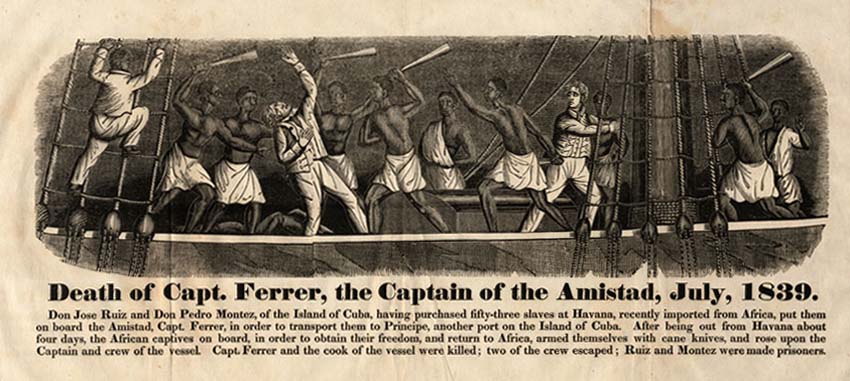 |
| Frontispiece image from A History of the Amistad Captives, compiled by J. W. Barber (New Haven, CT: E. L. & J. W. Barber Publishers, 1840) |
Singbe Pieh motivated the initiation of the evangelistic effort of the Congregational Churches in America through the American Missionary Association, an association which funded not only his and his fellow captives’ legal defense but also the liberated captives’ return to Sierra Leone. (In all fairness, not only the abolitionist Congregationalists funded the legal defense and restoration of the captives, but also northern Baptist and Presbyterian abolitionists.)
For the American public who read the newspaper accounts of his capture, trial, and restoration, Singbe Pieh was either a heroic figure or a fearsome one, depending on one’s opinion of African people.
 |
| Freedom Schooner Amistad |
But it is important to remember that it was only a moment, just a little over three years. Singbe Pieh’s life spanned about 25 years before the day in January 1839 when he was kidnapped and sold into slavery, and as many as 60 years afterward, depending on which account you believe.
You see, that is the problem about how we view Singbe Pieh. We treat him often as if his life began, one triumphant night in June 1839 when, after being terrorized repeatedly by the taunts of the ship’s cook about his Spanish captors’ intention eventually to butcher him and the others and sell them as food, he managed to break free of his chains and then to free others, break into a box of sugar cane swords, and attack the ship’s crew. They killed the captain... and the cook... and took the remaining crew prisoner.
That’s pretty amazing stuff. But his life included so much more that we know only shadows of. He was a husband and father of three, a rice farmer who lived in the Mendi village of Mani; so it is not difficult at all to imagine why he wanted to get back. But when he did manage to return, his wife and children were gone and the village laid waste – victims of a civil war that started while he was away. Singbe Pieh survived the Middle Passage and the American justice system. You would think he deserved a happier reward.
My new favorite author, the professor of history emeritus at John Jay College of Criminal Justice, City University of New York, in 1999 published an article in the Columbia University journal, Souls, which identifies itself as “A Critical Journal of Black Politics, Culture and Society.” The article was entitled, “Black Agency, in the Amistad Uprising: Or, You’ve Taken Our Cinqué and Gone – Schindler, Morphed into John Quincy Adams, Rescues Africans — a Retrograde Film Denies Black Agency and Intelligence, Misses What Really Happened, and Returns to the Conservative Themes of the Fifties; with an Account of What Really Happened, and a Few Words about Abolitionists as Fanatics.” By Jesse Lemisch (Souls, Winter 1999)
The Amistad in question here is the 1997 film by Steven Spielberg starring Morgan Freeman, Djimon Hounsou, and Matthew McConnaughey (oh! And Anthony Hopkins as former president John Quincy Adams – what is it, lately, with foreign actors recruited to play American presidents!). In his article, Prof. Lemisch points out that, for all Steven Spielberg’s good intentions in creating the film which at the time the director referred to as his most important work to date, for Lemisch the film was “a present-minded Nineties screed for white paternalism.” Prof. Lemisch points out that there was a distinct lack of back story included here. Singbe Pieh appears to have come up with the idea of revolt entirely on his own. Others join him, seemingly, because he has managed to free himself and looses their chains too. There is no indication of conspiracy or planning.
But the fact that, historically, the captives used a file to cut through their shackles – not a loosened nail to unlock them, as the movie shows – they must have devised a system together to hide the file. Furthermore, their knowledge of a sealed crate filled with swords and the speed with which they must have acted to open it and distribute them – since the crew on deck appears to have been taken completely by surprise – points to quite a bit of premeditation. Lemisch argues that the real story of La Amistad is not about a group of black people set free by the magnificent justice of a white people’s system of government or about black and white cooperation. The Amistad incident is about resistance and rebellion; it is about, as Lemisch puts it, “black agency.”
 |
| "The Revolt," one in the Amistad Mutiny series of murals (1938) by Hale Woodruff |
Then, the most abiding story about him after his return to Sierra Leone is that he became a slave trader there. And, no matter how much evidence there may be to the contrary the allegation keeps getting repeated. The most damning evidence to the contrary is that this part of his biography is actually taken from a novel, the author of which admitted that where there were gaps in the story, he made things up. ("Cinqué of the Amistad a Slave Trader? Perpetuating a Myth," by Howard Jones, Journal of American History, December 2000)
Why?
Not, why would people believe this? We know that!
No, Why, after his life was so piled high with misery, would Singbe Pieh not at some point have seen some enduring happiness? At some point, hasn’t he suffered enough? At some point, haven’t we all suffered enough?
__________________________
I don’t know if it’s a satisfying response for you. I know it isn’t entirely satisfying for me, but Jesus offered this response to his followers when they pressed him to know why people who seemed innocent should have been the subject of suffering... the Galileans whose blood Pilate had mixed with their sacrifices, the eighteen who died when a tower fell on them. He said, “Were any of these less righteous than any other ordinary people trying to live life as best they could? No.”
And then he told them a parable about a garden and a fruitless tree. The owner of the tree wanted to cut it down and replace it. The one who tended the garden, however, pleaded with the owner to allow him to fertilize it. “Let me dig around it and put manure around it,” the gardener said.
That, Jesus seems to say, pretty well sums up our condition: we are given lives abounding in manure because that is what enriches them. Granted, in the moment of suffering, these words do not come as much comfort, saying as they do that suffering is inevitable and perhaps even necessary, even if in it we can find new meaning and purpose for ourselves.
People caught in disaster don’t deserve it. There's no real mystery to it. They simply were as they were when misery began. It isn’t God’s will that people suffer, and they don’t go through it or succumb to it because they are worse sinners than anyone else. The world is as it is, says Jesus: Manure happens. But because it happens, we can be better; life can be better than it was.
Singbe Pieh and his fellow captives deserve to be recognized as something more than victims of their times or as justifiers of the American system. They deserve to be seen as more than people saved from perdition by a single man (John Quincy Adams) or group of people (abolitionists). They deserve to be recognized as human beings who when they saw the opportunity to reverse their fortunes, together tried. However difficult it may be this century and three-quarters later to see them clearly, we owe them at least that much recognition. And this is the day we in the UCC celebrate Singbe Pieh and all of them and the mystery of the tragedy they shared and the life we all share. From sadness and hardship, they were able to wrest redemption into the light of day.
And their story bore brilliant fruit: Something not often remembered is that their was the first of three great slave rebellions in a period of five years. In November 1841, nineteen slaves aboard the Creole, which was loaded with 153 slaves bound from Hamption Roads, Virginia, to New Orleans, Louisiana, overwhelmed that ship's crew and ordered them to sail for Liberia. Insufficiently provisioned for a trans-Atlantic voyage, the crew convinced the mutineers to allow them to sail for Nassau, the Bahamas, instead. Once arrived in the port of that British protectorate, despite repeated protestations from the American consulate, because British law forbade the ownership of slaves, Bahamian police set all but seven of the captives free. Those seven - three women and four children - elected instead to sail on to New Orleans.
Furthermore, in November 1842, hundreds of slaves of Cherokees in the Indian Territory, walked away from their masters and headed for Mexico, which also had outlawed slavery. [Here, the audio version of this sermon misrepresents the actual history. I apologize for the inaccuracy. -DD] The Cherokee Nation raised a militia which captured the slaves, just north of the Red River (Texas border). It is interesting also to note that, after this rebellion in 1842, there was not another slave rebellion until Harper's Ferry in 1859.
It can surely be no accident that, with the sensationalism of the Amistad story in the news in both the North and the South almost constant from 1839 until 1842, that the affirmative decisions in 1841 of the Federal District Court in New Haven and the U.S. Supreme Court influenced the resolve of those slaves to assume freedom when the opportunity presented itself. Slave revolts and rebellions such as those on the Creole and in the Indian Territory could not have occurred without conspiracy and planning of individuals convinced that freedom was within their grasp if they would only take it.
The inspiring agency of the Amistad captives continues to bear fruit today, in articles I have cited here, and in Civil Rights and Human Rights movements, here and across the globe.
And much as the Sequester threatens to recede our economy, because we know the story of the liberated Amistad captives, we know that there is hope. But we knew that already didn't we.
The one who told the parable of the fertilized fig tree is one who lived this reality himself. Our Jesus was arrested unjustly, and tortured, and executed for no good reason. But he would not be kept down; on the third day he was restored to life, gloriously and for ever, as a living example for us all.
We have that hope for ourselves, so let us be examples of the freedom that makes us free and the love that gives us life.
Thanks be to God. Amen.
Tuesday, February 26, 2013
Prayer with the UMWA

In July 2012, Patriot declared bankruptcy. A firestorm has issued out of the United Mine Workers of America, protesting the scuttling of all Patriot's assets including those pensions and health accounts. Many will be left destitute as a result.
 |
| From http://www.krcu.org/post/ coal-miners-protest-peabody-energy-st-louis |
God of all people great and small, we pray this day for the lowly and the powerful, that justice for all may be accomplished.
Many of us have come to know you in Jesus of Nazareth - the carpenter and carpenter's son who learned of labor through his trade. He, by his word and godly example has indicated to us what is holy and true and righteous.
We thank you for these people united in a common effort, appealing to the conscience of the leadership of a mighty company.
Sovereign God, I am the pastor of an historically white collar congregation, but today, I wear under my power suit a blue collar to signify unity with labor everywhere, but especially these coal miners here. They worked for Peabody for years, assuming that the work they had done would be appreciated in perpetuity by their former employer. But now they fear for their futures - that they may be left destitute by a corporation that made a mistake (and what a mistake!), five years ago. Now, the great claim scarcity and threaten the small.
We pray for these miners' former management, almighty God, for Peabody surely understands that, as Jesus said, "a worker deserves their wages," and as you have spoken through the prophet, we "shall see the fruit of our labors."
And we acknowledge that Jesus not only kept company with the lowly and vulnerable, the poor and the needy, but also with the powerful, the questionably ethical, and the outright corrupt. He befriended everyone for the sake of reminding us that we all are our brothers' and sisters' keepers. So, we pray that your Spirit - as it did in the unnamed centurion and Nicodemus, in Zacchaeus and Matthew - may work insidiously among those who make the financial decisions of this company,who could not decide as they do but for the profits these laborers made possible. Help them to remember their obligations to their sisters and brothers, duties they once claimed as their own and which - I venture to remind them in this prayer to you - they must again assume by the demands of justice and righteousness, by the fact that they would not be able to take up these duties were it not for the coal miners and their families who turned the wheels of their industry by the sweat of their brows and the strength of their hands.
"Let your justice roll down like waters and your righteousness like an ever-flowing stream!"
Decisions once made in strength may have been borne out in weakness, but abundance persists in this corporate giant. We see its evidence throughout our city in philanthropic work and impressive architecture. But Peabody can do more... and better!
Peabody's obligation to their workers remains, no matter how much they deny it. And their ability will not be overwhelmingly diminished by living up to the promises they once made to these people. This giant is strong and able.
O God of great and small, our Creator and our Guide, as once you did in an obscure place in the words and acts of a simple laborer, bring redemption here: In this day protect the lowly and the vulnerable through the righteous action of the great and the strong.
Your mercy is boundless, your compassion endless, your abundance eternal, your love infinite. Grant us all, your vision and a heart to do your will. And thus empower all your people to say, "Amen."
Sunday, February 24, 2013
On My Way
A sermon by Student Minister Reina Ueno, translated by the preacher. This English version was delivered in worship, February 24, 2013. To hear the audio of this sermon, please click here.Do you remember your hardest experience in your life? Or perhaps some life path that was difficult for you? I do not want to dwell on it very much, but I think each of us have had a tough time we can remember.
For the Lenten season, we remember the suffering of Jesus at
the same time all of us have to pass through hard places in our life jorney, at
some point. Today’s Scripture describes that Jesus is on his way to Jerusalem
and actually seems to suggest that Jesus will be faced physical crisis by going
up to Jerusalem.
Because today is Seminary Sunday, I have been asked to talk
about my life at Eden Theological Seminary. Before that, I would like to talk
about some stories about Japanese Christians who have supported in my studies
in the United States.
There are many active elder members who are more than 75
years old in my home church in Japan. They have experienced life in wartime in World War II. Some of them were Christians at that time; some had not become Christian yet. I heard lots of witness from them how they worshiped
in the wartime and how the Japanese church or Christian leadership have
struggled, that they eventually supported a Japanese military government even though
they actually did not want to do it. One lady said, pointing to the back end of
sanctuary, “Here, there was military policeman every Sunday when we had a Sunday
morning worship. They check up whether we worship not only Christian God but
also Japanese Emperor.” They always were suspected of spying for America
because they were Christian.
And I know that lots of people experienced Copernican paradigm shift from the end of war in 1945 to the time of after wartime. They totally lost their identity as Japanese. Even as Christians, they realized and were disappointed that Japanese Emperor was not God but he was a human being, and they as a result were not belonging to God’s kingdom. And some of them found that they truly oppressed other Asian countries.
Also, many of them have held onto very difficult feelings about Hiroshima and Nagasaki since the end of World War II. When I visited my home church last summer, some of elder members asked me seriously “How do American church think about Hiroshima and Nagasaki, now?” This question might be connected with their faith journey. I could not answer the question. But anyway, then so many Christians have experienced such a hard times and are also unique.
And I know that lots of people experienced Copernican paradigm shift from the end of war in 1945 to the time of after wartime. They totally lost their identity as Japanese. Even as Christians, they realized and were disappointed that Japanese Emperor was not God but he was a human being, and they as a result were not belonging to God’s kingdom. And some of them found that they truly oppressed other Asian countries.
Also, many of them have held onto very difficult feelings about Hiroshima and Nagasaki since the end of World War II. When I visited my home church last summer, some of elder members asked me seriously “How do American church think about Hiroshima and Nagasaki, now?” This question might be connected with their faith journey. I could not answer the question. But anyway, then so many Christians have experienced such a hard times and are also unique.
Their journey is part of my journey as a Japanese Christian.
I think I have a responsibility to understand historical facts and people’s
emotions, to rebuild relevant relationships, especially with Asian countries.
There is another story concerning the sexual minority issue.
I know one boy who struggled with his confusion between his body and soul. When
the boy noticed that he had biologically female body then he also realized that
he is not female but male. He was raised up by Christian mother and
non-religious father. He was baptized as a child. When he attended a high
school, which was only for girls, as a female student, he came out to his mother
and sisters.
His mother was so confused and blamed to herself because she thought she failed to raise up her daughter as a female. She believed that God created human being only biologically male and female according to a literal reading of the Scripture. It was huge crisis for both her faith journey and her daughter’s life but unfortunately there was no help from church. She and her daughter wanted to talk to a pastor but they could not. They were not totally sure the church could accept their situation. They could not get any information about sexual minority people or any positive perspective about the matters of sexuality both in the life of church and in pastor’s preaching. Since this mother was divorced, she somehow noticed the way of pastoral care that she was provided by her pastor. There was surely gentle prayer, but there was no appropriate instruction about concrete issue of relationship. So they hesitated to talk with a pastor and a relevant pastoral care has never happened at that time.
His mother was so confused and blamed to herself because she thought she failed to raise up her daughter as a female. She believed that God created human being only biologically male and female according to a literal reading of the Scripture. It was huge crisis for both her faith journey and her daughter’s life but unfortunately there was no help from church. She and her daughter wanted to talk to a pastor but they could not. They were not totally sure the church could accept their situation. They could not get any information about sexual minority people or any positive perspective about the matters of sexuality both in the life of church and in pastor’s preaching. Since this mother was divorced, she somehow noticed the way of pastoral care that she was provided by her pastor. There was surely gentle prayer, but there was no appropriate instruction about concrete issue of relationship. So they hesitated to talk with a pastor and a relevant pastoral care has never happened at that time.
Their journey is also part of my journey as a family member.
The transsexual boy is my youngest sister. She is officially male now. I
attended ONA conference yesterday and one of the important things I have heard
in the workshop is to name specific people who are marginalized. Because they
are not sure whether church welcomes them like my mother and my brother has
experienced. How do they know they are welcomed? There is no church proclaiming
Open and Affirming Congregation in Japan. Therefore I think I have
responsibility to work for LGBTQI people who are still strongly forced to be
hidden without any support.
So, let’s return to the Scripture.
Then some Pharisees came and said to Jesus, "Get away from here, for Herod wants to kill you.” Jesus said to them, "Go and tell that fox for me, ‘Listen, I am casting out demons and performing cures today and tomorrow, and on the third day I finish my work.”Why does Jesus call Herod a fox? Why does Jesus use this kind of bad word, even if Herod is actually bad person? Isn’t Jesus supposed to be gentle!
I think Jesus may be articulating how very much Herod differs
from himself. Jesus explains his own work specifically in this way: "I am
casting out demons and performing cures today and tomorrow, and on the third
day I finish my work."
The implication of this explanation might be: This is what happens when God is working among people. And this is what a true king of people has to do. But Herod never does that. Jesus is doing it today and tomorrow, and until he dies. Herod never even gets started in this way.
Yet today, tomorrow, and the next day I must be on my way, because it is impossible for a prophet to be killed outside of Jerusalem.
“I must be on my way.” This phrase of Jesus catches my
eye. “I must be on my way.” – What does
it mean?
I actually struggled with feeling some nuance in English for
this phrase. Pastor David taught me “way” has two different meanings in English - a
road and a practice. But still, I do not think I get the nuance of this
word in English.
So I will talk through the perspective of the nuance in Japanese
language.
To me, this phrase seems to be like Jesus is emphasizing “his
way” differ from Herod. And the way he must go down the road to the city of
Jerusalem is required from God. On the other hand, Jesus’ way of doing things
truly is applicable in both contexts. His way need not necessarily be the way
of a king. Jesus talks about what he was doing in his life and how he was
associated with people. He cast out demons, healed the sick, and finally, one
day, he would finish this work.
So, “the way” means not only the road but also the practice that
Jesus did in his life: casting out demons
and performing cures. Moreover, this should be the statement of the
obedience to God’s will. Not only for Jesus but also we must be on our way
because it is impossible to change God’s will.
We are strongly required to be on our way differently.
Likewise the elder Japanese church member experienced, my mother and my brother
struggled, and all of us have certain life journey, which is impossible to
refuse. In other words, through the prophet Isaiah: My thoughts are not your thoughts, nor are your ways my ways. (Isaiah
55:8)
My study at Eden is connected with the Japanese church
members, families, friends and American church, too. One of my hope in studying
at Eden is to discern how to compose these elements with my own context as a
single female Japanese pastor. It often causes isolation to me compared with
other students or other female pastors in Japan because simply American
Christian is majority and Japanese female pastor mostly get married with male
senior pastor. But I really appreciate that I am only one Japanese student at
Eden and one of a few single female pastor in Japan. It is unique and this is
the way I must be on that God required to me.
But, what is the purpose of this way? Why has God given us
this way?
I think the answer is in another Scripture for today. Here,
God speaks of a promise to Abraham. When Abraham looks back his journey in the
past he could not find any hope to have his child anymore. Abraham seems to
have a tendency to consider that God is not keeping the promise, because of
what has not yet happened in his life. But even though, back then, for Abraham
the facts were not yet in God’s favor, and Abraham could not find hope just in
that moment, God nevertheless asked him to see the hope in the sky. There were
stars like lights of hope.
In the Epistle to the Hebrews 6:13-20, the author explains
hope from God,
When God made a promise to Abraham, because he had no one greater by whom to swear, he swore by himself, saying, ‘I will surely bless you and multiply you.’ And thus Abraham, having patiently endured, obtained the promise. Human beings, of course, swear by someone greater than themselves, and an oath given as confirmation puts an end to all dispute. In the same way, when God desired to show even more clearly to the heirs of the promise the unchangeable character of his purpose, he guaranteed it by an oath, so that through two unchangeable things, in which it is impossible that God would prove false, we who have taken refuge might be strongly encouraged to seize the hope set before us. We have this hope, a sure and steadfast anchor of the soul, a hope that enters the inner shrine behind the curtain, where Jesus, a forerunner on our behalf, has entered, having become a high priest for ever according to the order of Melchizedek.
The purpose (goal) of our way required by God is hope. God is
providing hope even if we are on the hardest way. And this hope is a sure and
steadfast anchor of our soul. The hope enters the inner shrine, where Jesus, a
forerunner on our behalf, has entered.
We must be on our way today, tomorrow and the next day, following
Jesus in word and deed.
We are on our way differently, but we have the same hope holding you as an anchor.
Can you see the hope on your way? Yes, you can see it.
Sunday, February 10, 2013
Bearing the Glow
A sermon by the Rev. David Denoon for Boy Scout Sunday, February 10, 2013
An audio version of this sermon is available.
A video about our Boy Scout Sunday by Wade Smith of Channel 2 News is available.
I can’t tell you the number of ministers I knew in 2009 and 2010 who used Susan Boyle as a comparison for transfiguration, when she sang her way to the top of the competition in the television contest, Britain’s Got Talent. Homely in appearance when she took the stage, Ms. Boyle had a clarity of vocal tone and timbre that absolutely stunned her judges and a worldwide audience. She shone with a glory few would have imagined, based on appearance.
The story was heartwarming, but versions of it happen quite a lot. The question is, sometimes, whether the Glowing One will be able to bear shining for long. We all have our encumbrances. But there is such potential!
One imagines that Jesus’ disciples had their high moments and their low ones. In the story earlier in Luke, when Jesus makes apostles of seventy of them and sends them abroad into Galilee, they return with exciting tales of their successes, cures, and blessings (Luke 10). But when Jesus descends Mount Hermon, he finds them impotent before the challenge of a poor, raving boy.
All Christians stand in the glorious light of Christ’s transfiguration, the brilliance of Jesus’ glowing from the mountaintop. We emulate as well humility similar to that of the apostles, as they try to figure out what to do about it... because we like them have found ourselves glowing too, have known our shining moments, just like them. And we therefore also have found ourselves commissioned with a powerful and power-filled message. And (surprise! surprise!) we can be intimidated by the message that we have to carry forward, however – a message of peace and justice and wholeness and life.
What? Little ol’ me?
If we are puzzled by what we ought to do next, or just what we ought to do, then my advice would be simply for us to consider what Jesus’ first action was after the Transfiguration: he healed a boy. He found his disciples intimidated or overwhelmed by the task of providing care so he jumped in and did it. And this, like all of Christ’s works, may seem as though they were accomplished fairly quickly and completely, all at once.
The temptation in our modern world always seems to be to rush things, to expect immediate results. We have gotten too used to pushing a button and having an outcome immediately. We have grown too accustomed to waiting thirty minutes, at the most three hours if it’s a sporting event, and to be able at the end of that relatively brief span of time to know who emerges victorious or at least to witness how everything plays out.
It’s important to remember in our day and age that, there on the top of Mt. Hermon, or wherever this hill is near Caesarea Philippi in the Galilee, God through Christ had been putting things in place for at least a year and perhaps for almost three years. (That estimate of time comes if you read Mark’s version of the Transfiguration; if you read Matthew’s or Luke’s it’s been more like a thirty-year wait, since Jesus’ birth. And if you read John, which has no Transfiguration story but definitely bears an opinion about God had been stirring the pot and preparing the world for the Messiah since the beginning of time. For John, as for most Christians since John was written, the dark day on another hill near Jerusalem would have as part of it not only the cross of Calvary but the crux of history.)
Moses was on Mt. Sinai for eighty days and nights before his face began glowing... and didn’t stop. For God, a Psalmist once said, “a thousand years are like ... yesterday.” So, some things will take time. And for earthly forms to show forth the glory of God, time will be taken.
Last Monday, there was word all over about some changes that the Boy Scouts might be making to their rules regarding membership and leadership. The announcement came welcome to the ears of our congregation. We place few restrictions on membership and leadership in our church, and we want Scouting to be on the same page with us, because it’s part of our programming and therefore part of us.
The First Congregational Church of Webster Groves has had Scouting as part of our regular programming, ever since converting our first-west-of-the-Mississippi Boys Brigade into a Boy Scout Troop. Boys Brigade was an innovation to many Sunday Schools across the United States in the last decade or so of the 1800s, espousing the idea of ushering boys toward "Christian manliness." It originated in Britain, however, and remained something of a British vehicle; our own charter was granted by the Boys Brigade Canadian office.
Even though Lord Baden-Powell who founded the Boy Scouts was British, there was something about the slightly-less-sectarian and much-more-outdoorsy orientation of the Scouts, undoubtedly, that appealed to us as a church. And the fact that our Scouts could be chartered by an U.S.-based organization didn’t hurt.
Boys Brigades to this day are always attached to Christian faith communities, and those Scout troops such as ours with a legacy stretching to the days of the Boys Brigades retain that association in most cases. Scouting is a program of this church. We don’t acknowledge it much, and haven’t since, somewhere a long time ago, we just started taking it for granted.
First, we took for granted that it was part of us; then we sort of lost track of that fact. For many years, we have said that we sponsored a Boy Scout troop, and in the past decade or so that is what it has seemed like, since few to none of our boys or adults have been involved with the program which has carried on, sometimes maybe despite us. The charter you will see represented, later, is the annual permission given to us by the National Council of the Boy Scouts of America to call our boys program, Boy Scouts. We have met their exacting standards.
It was last September or so, after discussions began among frustrated church members who had been involved with Scouting that I discovered that I had the relationship backwards, and it was therefore only then I began to understand just why my church members were so upset as to want to send a letter or stage a protest or cut ties altogether...
The Scouts’ stated restrictions about members and leaders – even for all the assurances of an at-least-implicit don’t-ask-don’t-tell policy – is problematic for a church which started a Boys Brigade in 1908 because we thought it would help our own boys negotiate the challenging waters of boyhood and adolescence, helping them focus on Christian values of faithfulness, reverence, discipline, and self-respect. What isn’t right about that, even today, one hundred five years later?
But our concepts of faithfulness, reverence, discipline, and self-respect have changed, as from generation to generation in generations before us perspectives changed and therefore the interpretation of God’s word and will. I am assured by some that our fairly progressive stance on who ought to be able to join or lead our own Scout troop, or any program of our church, differs from that of the National Council of the Boy Scouts only by the sum of time it will take for Scouting to catch up. (Remember how long it took Jesus to get to that hilltop and be transfigured - a year, three years, a lifetime, or an eternity!)
This past week, we thought that it might not be decades in the sum but perhaps only years before our tension is resolved. After all, we only took our Open and Affirming stance, five short years ago, and its process took quite a while of self-examination and education.
Our Boys Brigade was retooled in 1910 from the stance it began with in 1908. The Scouts are focused on the outdoors and education while the Boys Brigade made no bones about training Christian spiritual soldiers. Well, the change in perspective we would like to see come about is not much different. And remember how long it took Jesus to get to that hilltop and be transfigured – one year, three years, thirty years, since the beginning of time!
Bearing the glow is one thing, we know, but getting to the glow is not a speedy process, ever, it seems.
There's something else that requires much time for a change in perspective or practice (glowing or abiding the shine):
Today, our local church is planning with the denomination for an Eastertide focus on environmentalism and stewardship. In fact, if today had not been Boy Scout Sunday and the recent events in our congregation and rumoring round Scouting’s National Council had not been so timely, I probably would have been part of the national Preach-In led by Interfaith Power and Light. This is, however, as close as I am coming to that observance – encouraging you in the tradition of our own scouts to plan to be part of the Green Team Lynda Morrison is trying to build up next Sunday with some new and motivated members.
But I was talking about glowing and what to do about it. I have been saying, and Tracey with the kids has been saying, for the past many weeks through our innovative Sunday School curriculum, We are the body of Christ. And that is the case, whether you assume the metaphor that we are each individually a different body part, or else the extension of the story we have heard today – that by faith you are being transfigured as Christ was, two thousand years ago on a hilltop in Galilee.
When Jesus came down off the mountaintop, unlike Moses he was no longer glowing; he looked himself again... and yet Peter, John, and James said that they had witnessed his transfigured reality. However momentarily it may have been, it was permanent in their eyes. They knew now what he was capable of.
The first act he performed after coming down off that hilltop was to heal a boy that no one else could heal. And he insisted that all they required was a measure greater of faith, for them to do the same. But that faith, as always in Jesus’ statements, was theirs to cultivate, theirs to believe in.
We know, don’t we, that the emanation of Christ is here and among us. We know that we are the body of Christ, transfigured and refigured so that we may operate in the world without having to disguise who we really are. We can provide the safe sanctuary for people who may not be harbored anywhere else safely and unconditionally. We can provide the extravagant welcome and the beloved community that is lacking in so many other places in our world, even Christian places. We can come down from our Galilean hilltop, our Palestinian peak, our high place in Webster Groves, and all our lofty locations and, whether inside our outside, ensure a healing environment for boys to become... what is it..?
An audio version of this sermon is available.
A video about our Boy Scout Sunday by Wade Smith of Channel 2 News is available.
SCRIPTURES FOR TRANSFIGURATION SUNDAY
The story was heartwarming, but versions of it happen quite a lot. The question is, sometimes, whether the Glowing One will be able to bear shining for long. We all have our encumbrances. But there is such potential!
One imagines that Jesus’ disciples had their high moments and their low ones. In the story earlier in Luke, when Jesus makes apostles of seventy of them and sends them abroad into Galilee, they return with exciting tales of their successes, cures, and blessings (Luke 10). But when Jesus descends Mount Hermon, he finds them impotent before the challenge of a poor, raving boy.
 |
| "The Transfiguration" from the Jesus Mafa series |
What? Little ol’ me?
If we are puzzled by what we ought to do next, or just what we ought to do, then my advice would be simply for us to consider what Jesus’ first action was after the Transfiguration: he healed a boy. He found his disciples intimidated or overwhelmed by the task of providing care so he jumped in and did it. And this, like all of Christ’s works, may seem as though they were accomplished fairly quickly and completely, all at once.
The temptation in our modern world always seems to be to rush things, to expect immediate results. We have gotten too used to pushing a button and having an outcome immediately. We have grown too accustomed to waiting thirty minutes, at the most three hours if it’s a sporting event, and to be able at the end of that relatively brief span of time to know who emerges victorious or at least to witness how everything plays out.
It’s important to remember in our day and age that, there on the top of Mt. Hermon, or wherever this hill is near Caesarea Philippi in the Galilee, God through Christ had been putting things in place for at least a year and perhaps for almost three years. (That estimate of time comes if you read Mark’s version of the Transfiguration; if you read Matthew’s or Luke’s it’s been more like a thirty-year wait, since Jesus’ birth. And if you read John, which has no Transfiguration story but definitely bears an opinion about God had been stirring the pot and preparing the world for the Messiah since the beginning of time. For John, as for most Christians since John was written, the dark day on another hill near Jerusalem would have as part of it not only the cross of Calvary but the crux of history.)
Moses was on Mt. Sinai for eighty days and nights before his face began glowing... and didn’t stop. For God, a Psalmist once said, “a thousand years are like ... yesterday.” So, some things will take time. And for earthly forms to show forth the glory of God, time will be taken.
Last Monday, there was word all over about some changes that the Boy Scouts might be making to their rules regarding membership and leadership. The announcement came welcome to the ears of our congregation. We place few restrictions on membership and leadership in our church, and we want Scouting to be on the same page with us, because it’s part of our programming and therefore part of us.
The First Congregational Church of Webster Groves has had Scouting as part of our regular programming, ever since converting our first-west-of-the-Mississippi Boys Brigade into a Boy Scout Troop. Boys Brigade was an innovation to many Sunday Schools across the United States in the last decade or so of the 1800s, espousing the idea of ushering boys toward "Christian manliness." It originated in Britain, however, and remained something of a British vehicle; our own charter was granted by the Boys Brigade Canadian office.
Even though Lord Baden-Powell who founded the Boy Scouts was British, there was something about the slightly-less-sectarian and much-more-outdoorsy orientation of the Scouts, undoubtedly, that appealed to us as a church. And the fact that our Scouts could be chartered by an U.S.-based organization didn’t hurt.
Boys Brigades to this day are always attached to Christian faith communities, and those Scout troops such as ours with a legacy stretching to the days of the Boys Brigades retain that association in most cases. Scouting is a program of this church. We don’t acknowledge it much, and haven’t since, somewhere a long time ago, we just started taking it for granted.
First, we took for granted that it was part of us; then we sort of lost track of that fact. For many years, we have said that we sponsored a Boy Scout troop, and in the past decade or so that is what it has seemed like, since few to none of our boys or adults have been involved with the program which has carried on, sometimes maybe despite us. The charter you will see represented, later, is the annual permission given to us by the National Council of the Boy Scouts of America to call our boys program, Boy Scouts. We have met their exacting standards.
It was last September or so, after discussions began among frustrated church members who had been involved with Scouting that I discovered that I had the relationship backwards, and it was therefore only then I began to understand just why my church members were so upset as to want to send a letter or stage a protest or cut ties altogether...
The Scouts’ stated restrictions about members and leaders – even for all the assurances of an at-least-implicit don’t-ask-don’t-tell policy – is problematic for a church which started a Boys Brigade in 1908 because we thought it would help our own boys negotiate the challenging waters of boyhood and adolescence, helping them focus on Christian values of faithfulness, reverence, discipline, and self-respect. What isn’t right about that, even today, one hundred five years later?
But our concepts of faithfulness, reverence, discipline, and self-respect have changed, as from generation to generation in generations before us perspectives changed and therefore the interpretation of God’s word and will. I am assured by some that our fairly progressive stance on who ought to be able to join or lead our own Scout troop, or any program of our church, differs from that of the National Council of the Boy Scouts only by the sum of time it will take for Scouting to catch up. (Remember how long it took Jesus to get to that hilltop and be transfigured - a year, three years, a lifetime, or an eternity!)
This past week, we thought that it might not be decades in the sum but perhaps only years before our tension is resolved. After all, we only took our Open and Affirming stance, five short years ago, and its process took quite a while of self-examination and education.
Our Boys Brigade was retooled in 1910 from the stance it began with in 1908. The Scouts are focused on the outdoors and education while the Boys Brigade made no bones about training Christian spiritual soldiers. Well, the change in perspective we would like to see come about is not much different. And remember how long it took Jesus to get to that hilltop and be transfigured – one year, three years, thirty years, since the beginning of time!
Bearing the glow is one thing, we know, but getting to the glow is not a speedy process, ever, it seems.
There's something else that requires much time for a change in perspective or practice (glowing or abiding the shine):
Today, our local church is planning with the denomination for an Eastertide focus on environmentalism and stewardship. In fact, if today had not been Boy Scout Sunday and the recent events in our congregation and rumoring round Scouting’s National Council had not been so timely, I probably would have been part of the national Preach-In led by Interfaith Power and Light. This is, however, as close as I am coming to that observance – encouraging you in the tradition of our own scouts to plan to be part of the Green Team Lynda Morrison is trying to build up next Sunday with some new and motivated members.
But I was talking about glowing and what to do about it. I have been saying, and Tracey with the kids has been saying, for the past many weeks through our innovative Sunday School curriculum, We are the body of Christ. And that is the case, whether you assume the metaphor that we are each individually a different body part, or else the extension of the story we have heard today – that by faith you are being transfigured as Christ was, two thousand years ago on a hilltop in Galilee.
When Jesus came down off the mountaintop, unlike Moses he was no longer glowing; he looked himself again... and yet Peter, John, and James said that they had witnessed his transfigured reality. However momentarily it may have been, it was permanent in their eyes. They knew now what he was capable of.
The first act he performed after coming down off that hilltop was to heal a boy that no one else could heal. And he insisted that all they required was a measure greater of faith, for them to do the same. But that faith, as always in Jesus’ statements, was theirs to cultivate, theirs to believe in.
We know, don’t we, that the emanation of Christ is here and among us. We know that we are the body of Christ, transfigured and refigured so that we may operate in the world without having to disguise who we really are. We can provide the safe sanctuary for people who may not be harbored anywhere else safely and unconditionally. We can provide the extravagant welcome and the beloved community that is lacking in so many other places in our world, even Christian places. We can come down from our Galilean hilltop, our Palestinian peak, our high place in Webster Groves, and all our lofty locations and, whether inside our outside, ensure a healing environment for boys to become... what is it..?
"physically strong, mentally awake, and morally straight"
Subscribe to:
Posts (Atom)